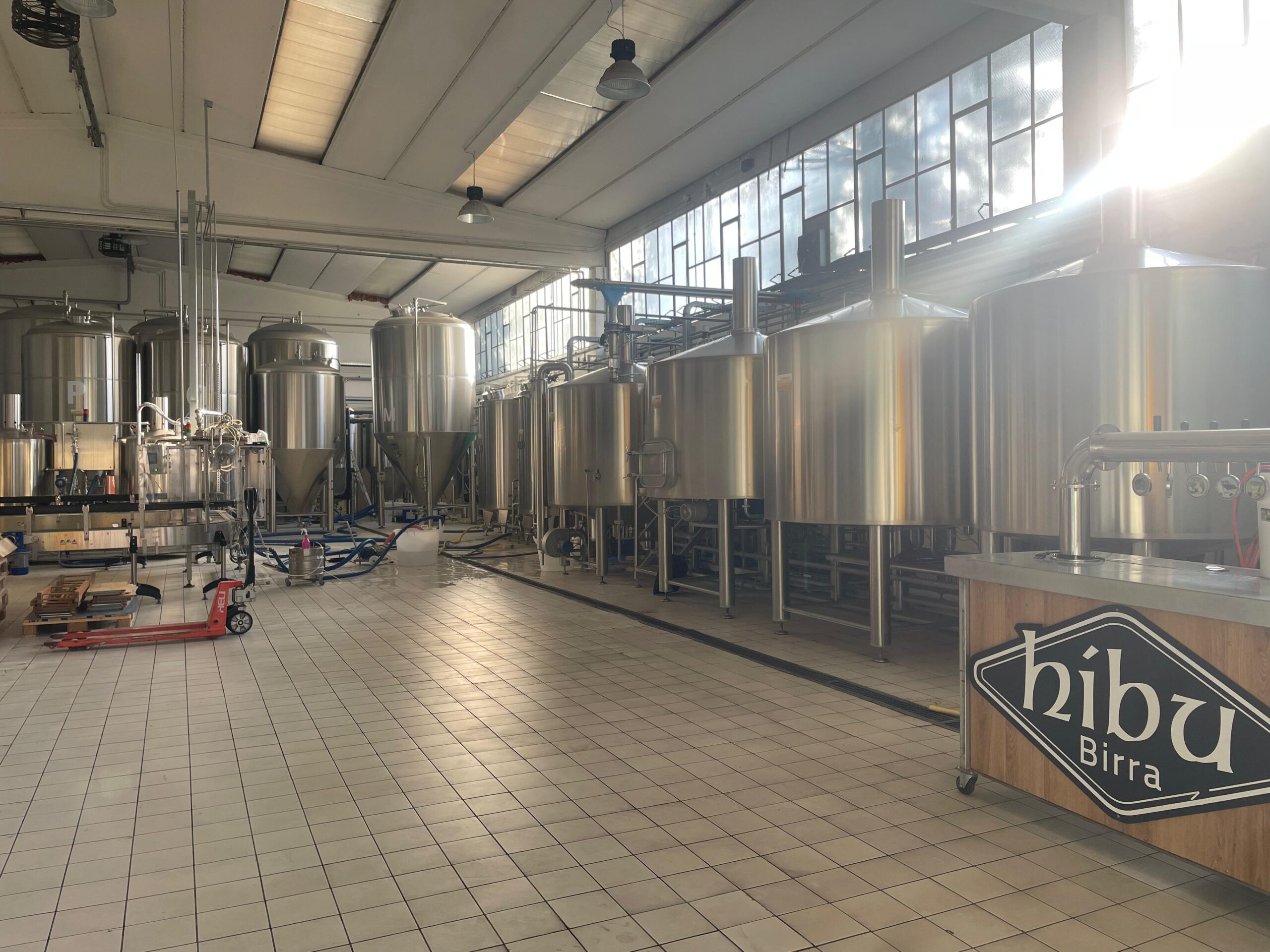
There are stories that do not begin with a business plan, but with curiosity and intuition. The late 1990s. Raimondo Cetani, like an alchemist, experiments at home with a small 20-litre piece of equipment. In 2003, he involved two friends: Gianluca and Lorenzo. The acquisition of a 100-litre system marked a first leap forward, even if the outfit remained that of enthusiasts and hobbyists. The experiments went smoothly and, in 2007, the company Birrificio Hibu was officially founded. For the partners, however, they still had a second job. The real turning point came in August 2010, with the commissioning of the first 500-litre BBC Inox brewhouse, installed in Raimondo’s garage in Cornate d’Adda (MB). A year later, the brewery moved to Bernareggio, expanding the plant and purchasing new vats. A TEM bottling machine and a SIFA monobloc kegging machine also arrived. 2015 marked another turning point. The final move to Burago di Molgora (MB) opened a new phase. Tommaso Norsa joined the company, the plant quadrupled in size, the corporate structure changed and production flourished significantly thanks to the introduction of the 2,000-litre Easybräu-Velo semi-automatic brewhouse – a branch dedicated to beer production by TMC Padovan, now part of the Omnia Technologies group – flanked by four 40-hectolitre vats (double brew) and four 20-hectolitre vats (single brew). Hibu definitively consolidates its craft identity. Creating easy-to-drink beers without ever compromising on craftsmanship and enjoyment.
Don’t Stop Me Now
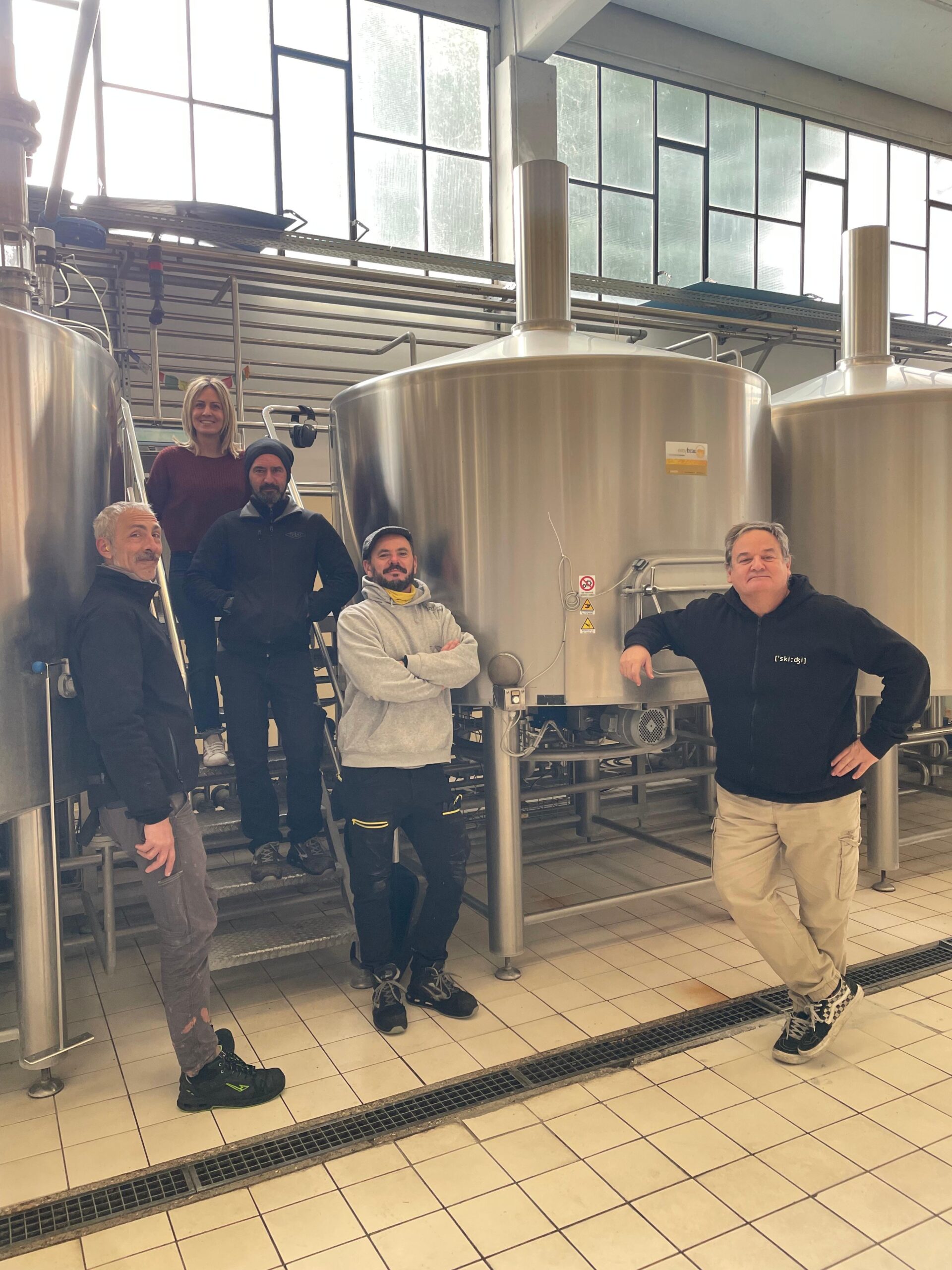
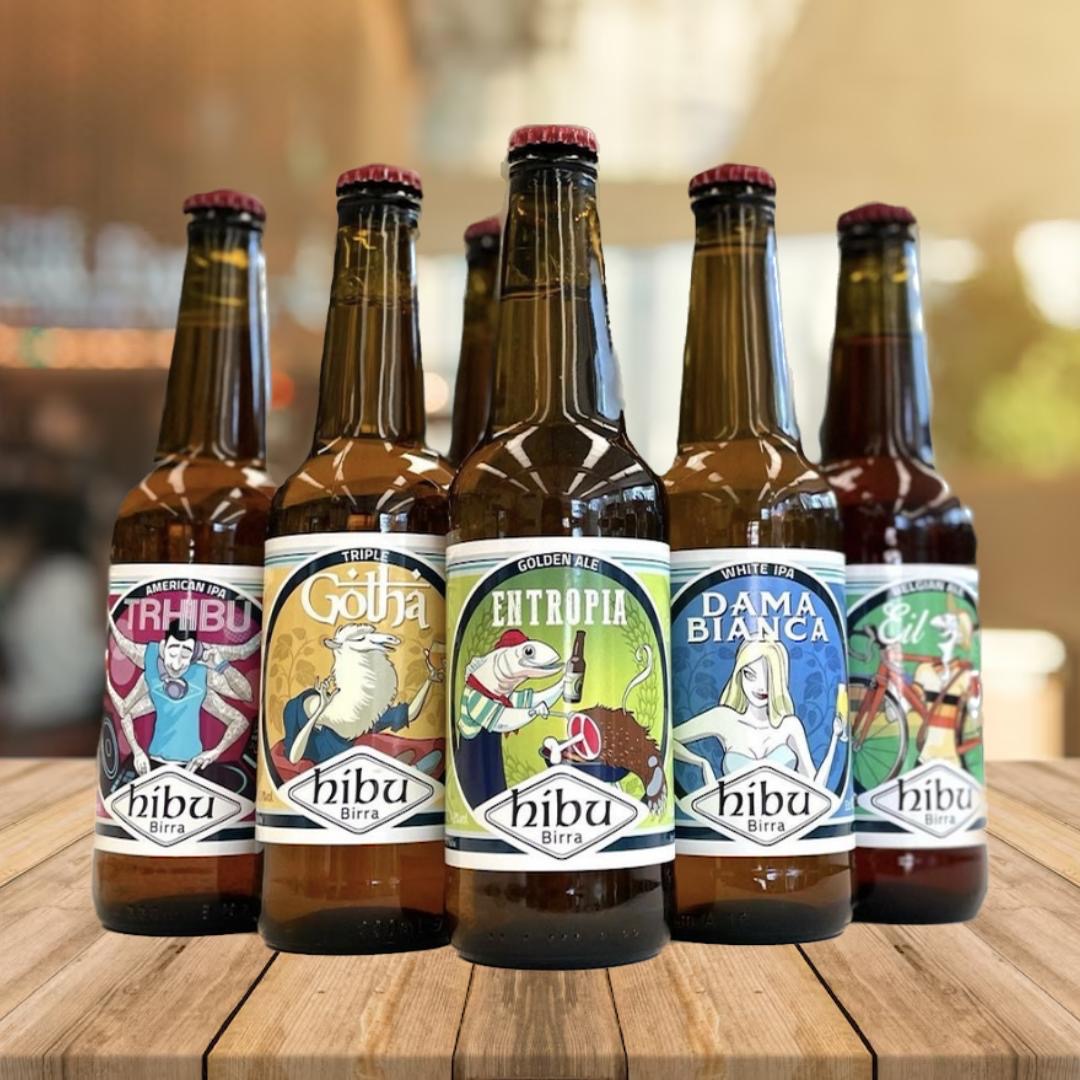
September 2017: a reversal destined to cause controversy. The facilities and brand were absorbed by Dibevit Import, a company specialising in the import of premium and special beers from the Heineken Group, now incorporated into it. For many, this was interpreted as a sign of a supposed departure from the craft spirit. Adulthood, however, requires a broader view. The brewing identity remained strong, as did the presence of Raimondo and Tommaso. Meanwhile, technology, production volumes and know-how improved. The result was a tangible enhancement on all fronts: from product characteristics to organisational solidity, to the ability to tackle more complex markets. The parenthesis closes in December2021, after years complicated by the pandemic. The partners are buying back their shares and returning Hibu to a smaller, more independent size. A return to its origins only in appearance: what emerges is rather a virtuous synthesis. One made up of greater awareness and an even more defined vision, built thanks to the skills and technologies assimilated along the way. For those who wish to learn more about this crucial transition, we recommend reading Andrea Turco’s interview with Tommaso Norsa in Cronache di Birra, which will help to clarify any doubts. Today, Hibu has eight employees. In production, founder Raimondo Cetani leads the team, supported by brewers Nicola Magnani and Giuseppe Tomasoni; Massimo Gnocchi and Andrea Deantoni are responsible for packaging, warehouse management and events. On the commercial side, Tommaso Norsa coordinates activities in synergy with Simona Crippa in administration and Giacomo Clemente in the role of Brand Ambassador. Giuseppe Ferrario, a graphic designer and illustrator from Milan, has always collaborated on the aesthetic aspect of the labels. Each beer also takes shape through a dedicated character, capable of describing its characteristics or ironizing about its type: a visual language that completes the brewing story and strengthens the dialogue with the consumer.
Production, volumes and daily monitoring
Production is divided into three lines: classic, refined and seasonal. This segmentation is also directly reflected in the brewhouse, which is organised into two systems. The first manual 5-hectolitre system is dedicated to seasonal and one-off productions. The second semi-automatic 20-hectolitre system is used for beers produced throughout the year. After the industrial period, when volumes reached almost 9,000 hectolitres, today’s maximum production capacity stands at 5,000 hl/year. The daily schedule includes up to three brews per day, for a total of about 60 hectolitres of wort. Once the tumultuous fermentation is complete, the beer is transferred to 12 fermenters with variable capacities of 5, 10, 20, 40, 50, 80 and 100 hectolitres. 70% of the packaging is destined for 24-litre Polykeg disposable kegs. The remainder is packaged in 33 cl bottles.
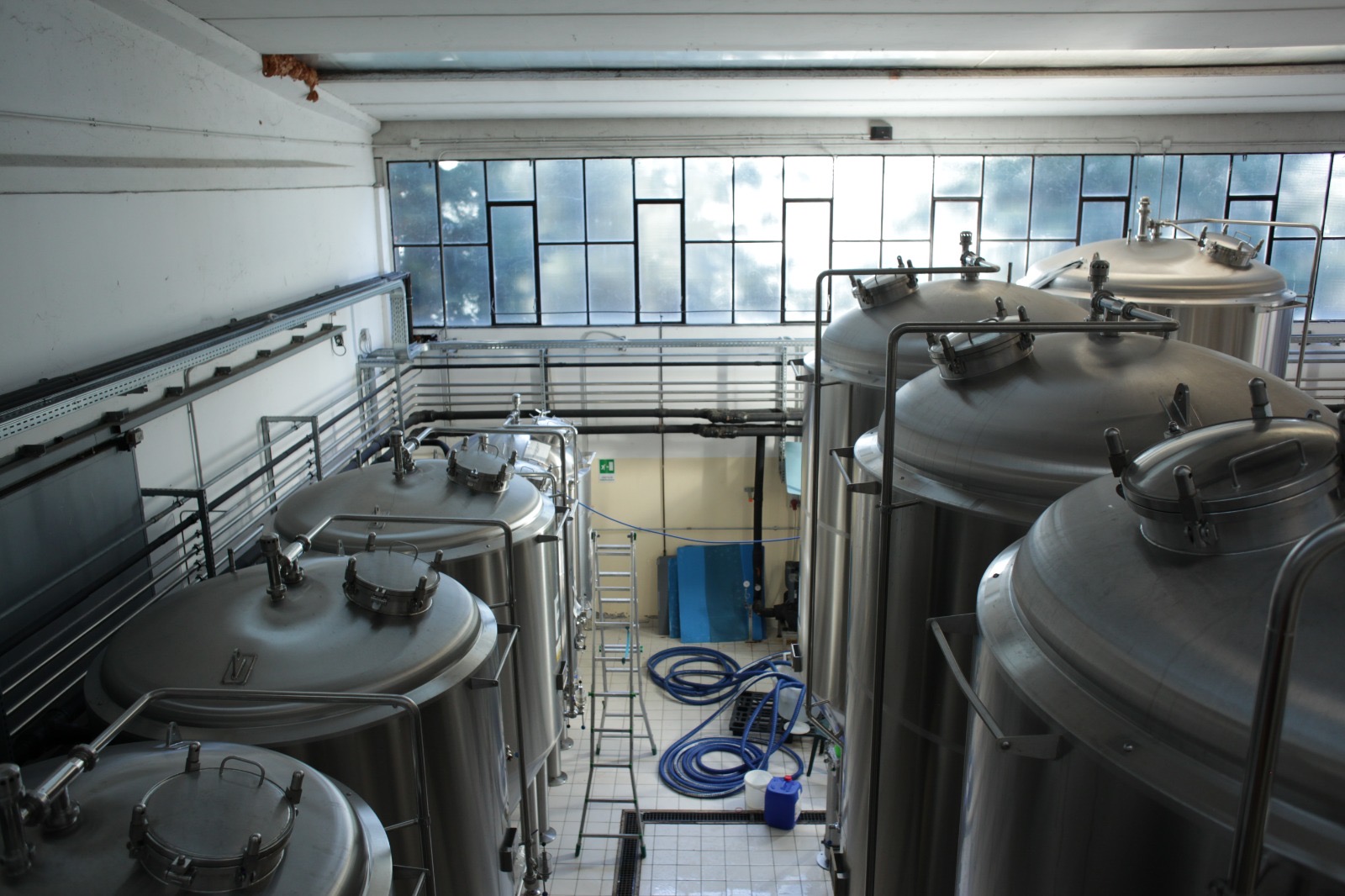
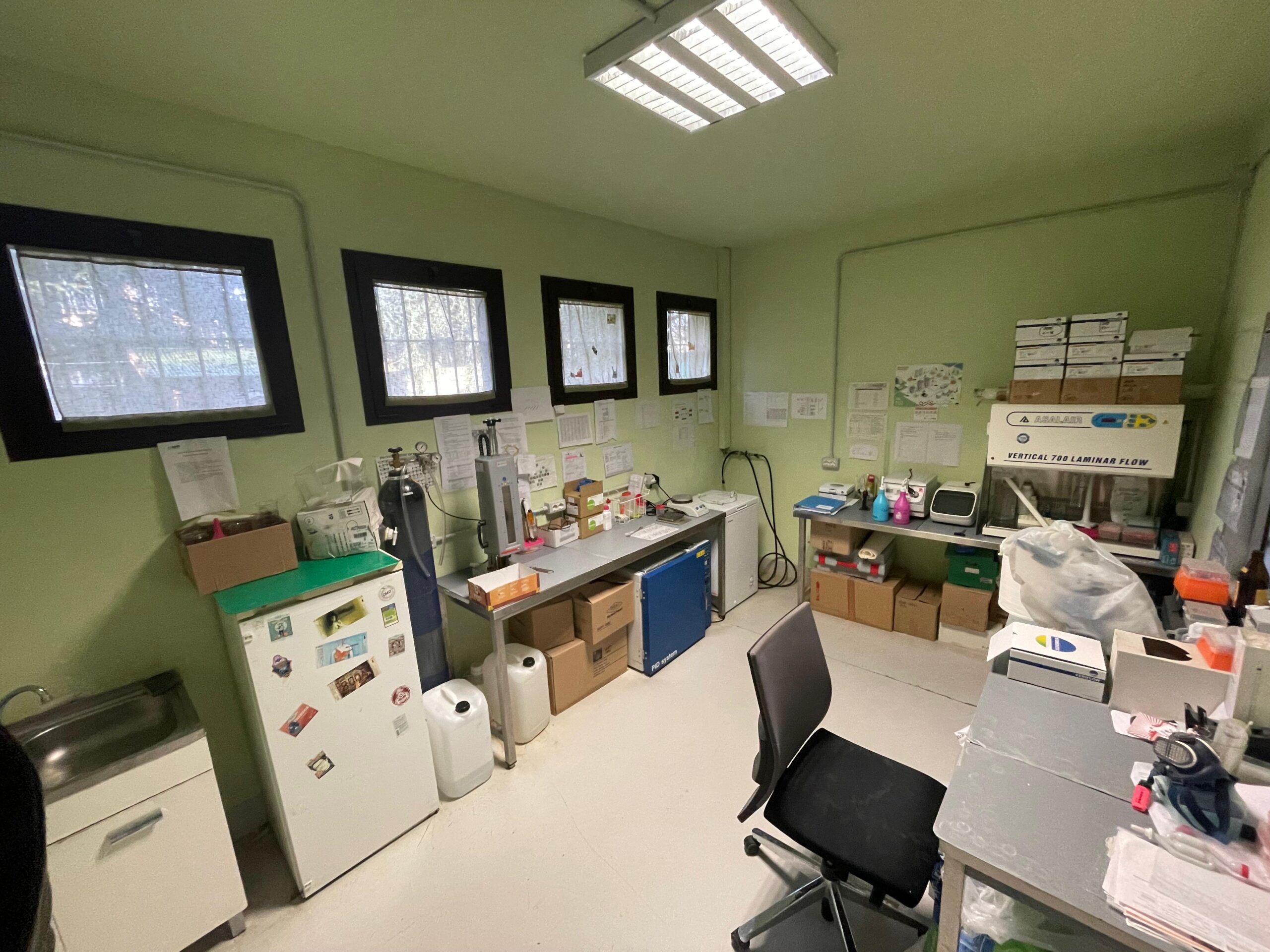
Only Christmas beer is packaged in 75 cl format. Although recognised as an interesting format, cans are currently considered premature for a market that Hibu mainly serves through the catering channel. This is a positioning choice rather than a fashion choice. In terms of refermentation, the brewery mainly uses the isobaric method, which covers almost 95% of production, alongside bottle refermentation for Belgian-inspired styles and seasonal beers. The bottling machine is an automatic isobaric Cime Careddu with 12 spouts and a theoretical capacity of 3,000 bottles/hour; Hibu consistently produces 2,200-2,500 bottles/ hour. The four-head B.R.A. keg filling machine, equipped with a palletiser, allows up to 100 24-litre kegs to be packaged per hour. A key role is played by the SPX separator, a clarification centrifuge that not only speeds up filtration times but, above all, ensures greater consistency in quality, significantly reducing minor process obstacles and standardising the final result. Quality control is comprehensive, thanks to the in-house laboratory. Constant monitoring through analysis allows the status of the beer and its chemical and physical variations to be checked, step by step, from the wort to the finished product. An intensimeter, oximeter, plate and microscope – used for cell counting during yeast recovery – are just some of the instruments used. For microbiological analysis, Hibu relies on a Biomerieux PCR, which allows the beer sample to be analysed in about five hours . And then there is the final check, the one that never lies: tasting. When you open a bottle, the quality test is the one that – for some reason – always manages to get everyone to agree!
Starting points
The raw materials speak different languages. The malts come mainly from Germany, Austria and England, with Belgian special malts playing an important role. The hops come from Slovenia, Slovakia and Germany, with a more exotic touch added by varieties from Oceania, New Zealand and the United States, used mainly in high fermentation. The yeasts are recovered and inoculated up to the fifth generation. Denmark, France, Belgium and Germany define their origin. An approach that combines skill and an international flair.
The watchword: smoothness
Production encompasses both top and bottom fermentation, but remains faithful to one non-negotiable principle: smoothness. There is no pursuit of excess for its own sake. Every pint must be easy to drink. This clear, consistent philosophy runs through the entire range. Fifteen styles are currently in production. With the arrival of spring, it is impossible not to mention Avanti March!, their Spicy Saison – a Belgian style originating in the Wallonia region, with an alcohol content of 6.5%. Barley and wheat form the cereal base, while pink pepper, ginger and bitter orange peel are added during the boiling phase. The colour is amber, with a fine, persistent head. The nose reveals fruity notes, hints of fresh bread and a hint of citrus. The spicy nuance adds an intriguing bouquet with a strong personality. In a brewing landscape increasingly crowded with extreme experimentation, choosing simplicity as a common thread is not a sacrifice: it is an act of courage. And, today, it is also a luxury for those who choose to drink it. «For me, beer is a product to be shared, it is social. It is not an elitist product, but a liquid that embraces and simply wants to be tasted. A pleasure. That’s how we see it. We don’t make beers to enter competitions, in fact, we’ve probably never entered one. We have always focused on producing beer that everyone can enjoy. Even when we tackle styles such as IPA, we avoid excessive bitterness or aroma: we aim for balance. Always», so says Nicola Magnani, brewer, who accompanied us on our discovery of Birrificio Hibu.
Craft yes, but with industrial know-how
Transformation only occurs when opposites are integrated. Alchemists talk about transmutation: turning lead into gold. Dante, on the threshold of Purgatory (Canto IX), entrusts the same concept to the powerful metaphor of the two keys. One silver and one gold. Both are needed to gain access and continue the journey. Hibu’s journey resembles this image. It has gone through different phases, changing form and tools, without ever losing its centre of gravity. The craft soul has remained intact, while industrial know-how has been assimilated as a means, not an end. Not to distort itself, but to improve. Recognising its limits and overcoming them. After all, growing means just that: integrating, creating new balances. Because when a journey is authentic, it does not stop: it evolves. So, let’s allow ourselves one last reference to Queen: The Show Must Go On!