
The beverage sector is a strategic sector for the national agri-food economy, as confirmed by data from Nomisma’s latest analysis, presented last April in Verona during Vinitaly 2026. The sector, which faces constant tariff and geopolitical pressures, is adapting to new consumption patterns whilst still striving to grow, amidst conflicting trends and energy crises. However, one cannot overlook the cultural transformations currently taking place, just as one cannot ignore changing tastes. It is therefore necessary to adapt in order not to lose competitiveness, and to look around to assess the various markets. We discussed this, and much more, with Emanuele Di Faustino, Head of Industry & Retail at the Bologna-based research firm.
The current geopolitical landscape inevitably calls for reflection on the energy issue. This is a key concern for businesses, which are facing planning difficulties, rising costs and shrinking margins. In your view, is the situation today more challenging than it was four years ago, at the start of the Russia-Ukraine crisis?
‘Over the last ten years, we have become accustomed to living with a level of uncertainty that has now become the new normal. Consequently, companies must learn to manage instability as a structural feature of the environment in which they operate. In my view, the current crisis is even more serious than that linked to the conflict in Ukraine. What is happening in the Middle East is, in fact, having an even more significant impact on energy prices, with knock-on effects on numerous strategic sectors, including transport and logistics, which are crucial for an export-oriented sector such as the drinks industry. The rise in energy costs inevitably leads to higher prices for many related raw materials. One need only think of glass, the production of which requires high energy consumption, or plastic packaging, the cost of which is closely linked to the price of oil, from which it is derived. There are, therefore, several factors affecting companies’ operating costs’.
And how will companies manage these price rises?
‘In the short term, they will probably be able to absorb some of these costs, but in the medium term they will inevitably be forced to pass on these increases to final prices. Should the crisis continue, it would therefore be reasonable to expect a further rise in inflation, with clear effects on the shopping basket, including drinks. In such a context, precise planning becomes particularly challenging for companies in the drinks sector. If we add to this the issue of US tariffs, I believe that the ability to diversify markets – broadly and as flexibly as possible – is now a key factor in ensuring stability and adaptability. Of course, this is not always an easy goal to achieve: it is not possible to shift goods and commercial strategies from one market to another in the space of a few days’.
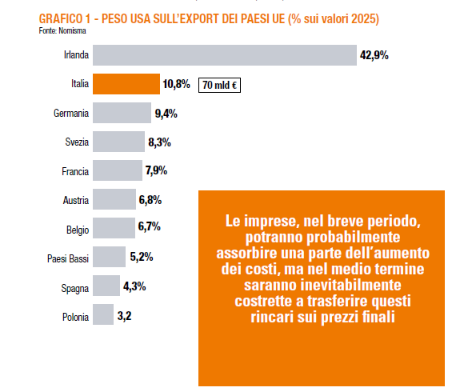
It’s a bit like saying: let’s come up with a Plan B to get round the US market. It’s neither feasible nor something that can be done straight away
‘The US is far too strategic a market for the drinks sector. It is the main destination for our exports, a key market which, at least in the short term, is extremely difficult to replace’.
Data presented at Vinitaly, from Nomisma’s research, points to a rediscovery of the European market…
‘Analysing the target markets where Italian beverage exports exceed 90 million euros, we must note that the only ones showing robust growth are, in fact, the European markets.
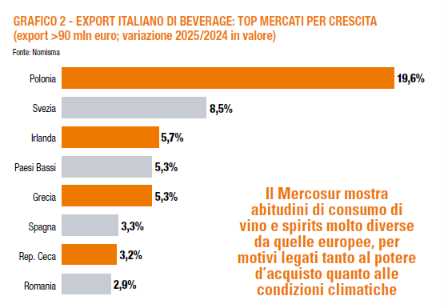
In (geographical) Europe, there are some very interesting markets, including France and Switzerland, which are our fourth and fifth largest export markets respectively. In France, in particular, Prosecco continues to record significant growth rates, driven by consumers’ strong and consistent appreciation of Italian products. Other European markets experiencing growth in demand for Italian products include Poland (a 19.6 per cent increase in beverage exports in 2025 compared with 2024), Sweden (8.5 per cent) and Ireland (5.7 per cent)’.
The United Arab Emirates would also be an excellent destination, were it not for its geographical location at present…
‘Dubai, at least before the conflict, had a high proportion of expats: those who move there for work do not give up life’s pleasures. The same applies to tourism. Consequently, over the years, the hospitality sector has seen growing demand for wine and other imported drinks, including ‘Made in Italy’ products’.
Let’s turn our attention westwards once more. On 1 May 2026, the iTA between the EU and Mercosur came into force: could this bring about any changes for Italian exports of drinks?
‘The Interim Agreement certainly represents a significant opportunity for Italian companies, not least because, over the years, we will see a gradual reduction in tariffs on both wine and spirits. However, it must be said that this bloc (Argentina, Brazil, Paraguay and Uruguay, ed.) has an approach to the consumption of wine and spirits that is profoundly different from ours, for reasons linked to both purchasing power and climate’.
Which markets, on the other hand, are seeing a slowdown in Italian imports?
‘Among the main export markets, in addition to the United States (which alone accounts for 22 per cent of Italian beverage exports and which recorded a 7 per cent fall in demand for Italian products between 2024 and 2025), there is also a decline in exports to Germany and the United Kingdom, the second and third largest export markets respectively. Germany is currently in a recession and remains a strongly price-driven market; despite this, it remains central to the sector, with exports worth around 1.6 billion euros in 2025, albeit slightly down on the previous year. Similar considerations apply to the United Kingdom, where price is a determining factor. This, too, is a market of great economic importance, with exports amounting to around 1.1 billion euros in 2025, but which has seen a significant decline over the past year (-6.9 per cent)’.