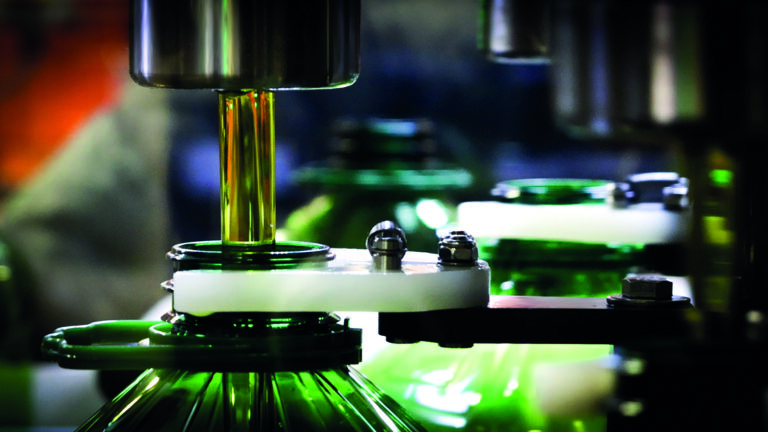
The bottling room has almost doubled in size, there are seven non-stop labelling stations, 360° optical control of each bottle, a double-skid microfiltration system and full supply chain traceability. These are some of the results that Vitevis – over 1,200 active members on 2,700 hectares of vineyards between Verona and Vicenza, with a production of almost 18 million bottles per year – has achieved thanks to the major renovation of the bottling line at the production site in Montecchio Maggiore (VI), with a 25% increase in productivity compared to the previous configuration.
This is a significant achievement, completed this spring after four weeks of intense work, which will bear fruit starting from the 2026 harvest.
On Friday 10 July, an open day will be held for members, who will be able to see for themselves the significant benefits that will result from the installation of new machines for labelling, capping, and handling bottles and cartons.
For the Montecchio production site, this is a radical change, starting with the management of the spaces. The layout has been completely redesigned from scratch, bringing the operating area to almost double that of the previous configuration: more space means smoother production flows, operators working in better conditions, and processes that are easier to control and manage.
New multi-layer epoxy resin flooring, a perimeter channel for the hygienic washing of hidden areas, and walls with washable enamel: each choice creates the conditions in which quality can be consistently guaranteed.
“With this investment, our company is at the forefront of winery technology,” says Gianfranco Gambesi, General Manager of the Vitevis Group, “because the 35% increase in productivity compared to the previous configuration translates into greater efficiency per unit produced, lower consumption of resources and a reduction in process waste, a figure that is perfectly consistent with the production approach reflected in our sustainability report. In other words, it means improved quality, process implementation and greater competitiveness in the markets.”
The investment in the bottling line is consistent with the actions of the SOVANO and CONDIVISO projects, both of which are aimed at reducing the environmental footprint of the supply chain and introducing innovation in the management of the vineyard and the winery. For Vitevis, production efficiency and environmental responsibility are complementary elements of the same strategy.
Systematic quality control
The main element of discontinuity compared to the past lies in the management of quality control. Before entering the labelling area, all capped bottles – still or sparkling – undergo an optical check for the presence of caps, with automatic rejection on the platform. This is followed by a capping control station with a camera system, integrated with the filling level check.
Thanks to this type of automation, occasional checks can be eliminated and replaced by an integrated and continuous system along the entire line, so that any non-conformity is intercepted and discarded without ever interrupting production.
In labelling, a dedicated system performs a complete reconstruction of the bottle’s solid of revolution for a 360° analysis of the applied label. Each station has its own independent reject area: the line does not stop, and quality is not compromised.
The labelling machine works with seven operating stations in non-stop mode: no stop for format changes, more precise operator supervision, direct productivity growth. The crating is entrusted to an automatic monobloc with a cell inserter, to protect the integrity of the labels. The process ends with the automatic application of the SSCC label on each pallet, demonstrating the traceability of the supply chain.
Still and sparkling wines: dedicated facilities
Handling very different types of wine with the same care – still and sparkling wines, each with its own temperature, pressure and time requirements – calls for specific solutions.
For cold-bottled sparkling wines, a new air-conditioning unit ensures strictly controlled temperature and air speed conditions, a critical variable for the quality of the finished product.
For still wines, a new capsuling machine with electronic pneumatic adjustment ensures uniform application at any line speed.
Finally, the double-skid microfiltration system allows for quick changeovers between wines of different colors and sanitization of the inactive circuit during production: less downtime, less risk of cross-contamination, and greater operational continuity.