We often hear about young people becoming increasingly isolated, disconnected from real-life relationships, and digitally isolated. But the conversations they share online every day tell a different story: that of a generation that continues to seek relationships, belonging, and moments of conviviality, albeit through new and ever-evolving forms.
From this insight, Together Lab was born, the new permanent observatory on contemporary sociality promoted by HEINEKEN Italia as part of the #Together campaign. This year, the lab evolves, choosing to observe sociality through the analysis of spontaneous online conversations. The lab was created in collaboration with a team of researchers from IULM University, coordinated by Mauro Ferraresi.
The project stems from the desire to listen to young people and observe sociality as it takes shape and is narrated every day on digital platforms: a new way to capture the authentic evolution of being together and understand how the languages, places, and rituals of conviviality are changing. The social media monitoring effort analyzed over 14,400 pieces of content spontaneously posted by young people between the ages of 18 and 35 on major social platforms. Each platform offers a different grammar of social interaction: TikTok‘s immediate, identity-driven, and performative language complements Instagram’s more aesthetic and aspirational narrative; Reddit favors more in-depth, discussion-oriented conversations, while YouTube and Facebook offer different forms of storytelling, discovery, and sharing. This diversity of languages allows for a more complete and authentic picture of how Gen Z and Millennials describe and experience their relationships.
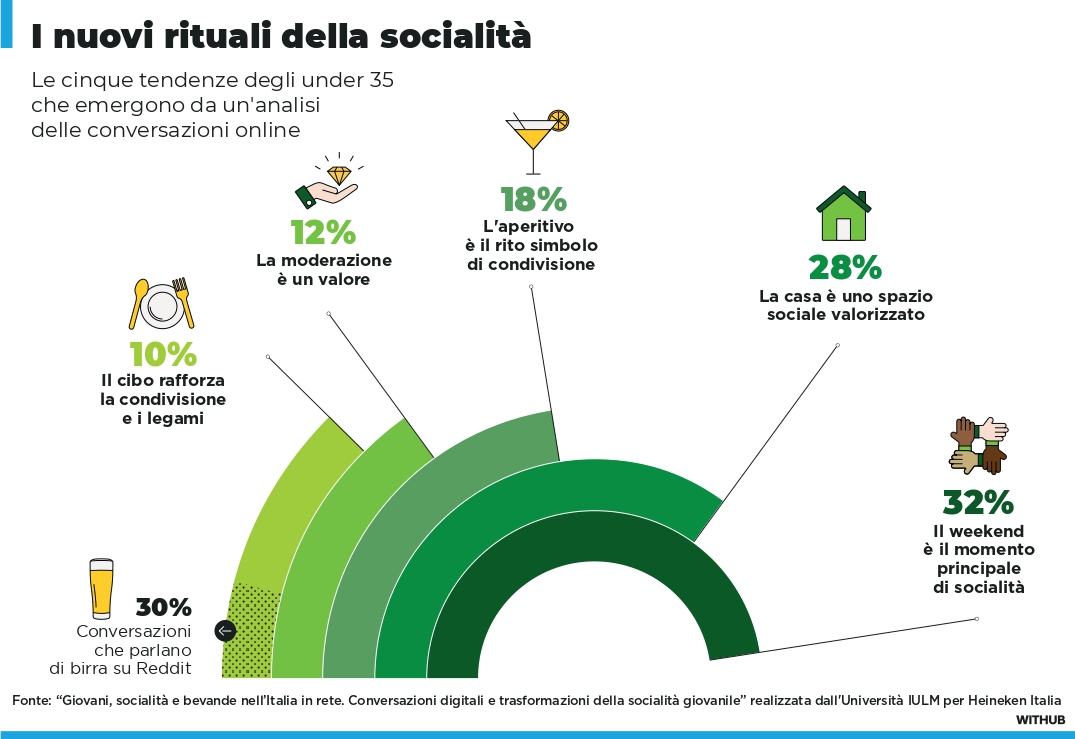
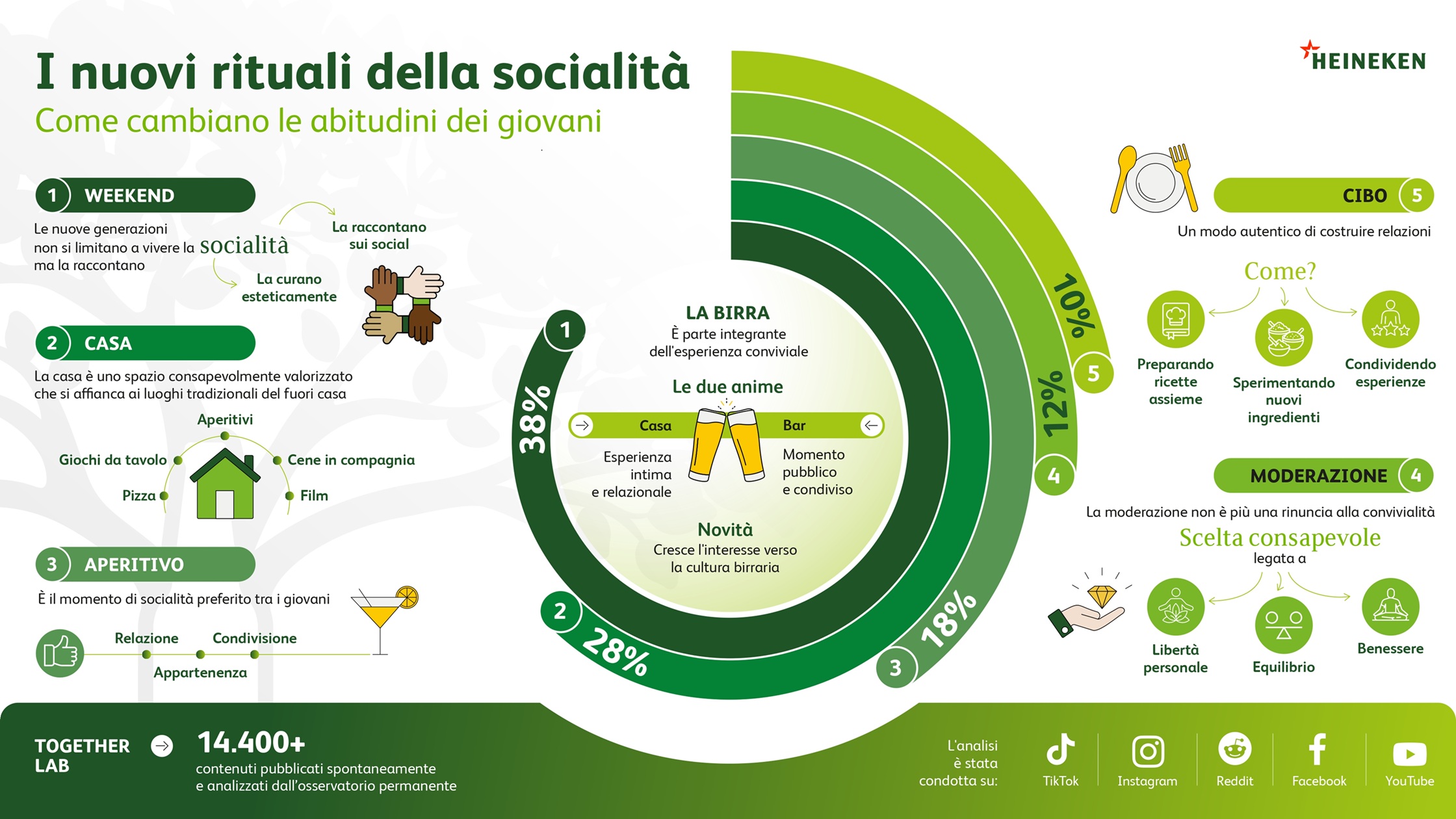
The qualitative analysis of digital conversations reveals five trends that illustrate how those under 35 are rewriting the rules of social interaction. The weekend continues to be the preferred time for socializing (32%) and is increasingly shared between experiences away from home and occasions within the home. Even the home is becoming a chosen and valued social space (28%), alongside eating out, which still represents the primary way to spend time together. Indeed, the aperitif confirms its role as a “symbolic ritual,” transforming into an opportunity for connection, belonging, and sharing (18%); moderation is establishing itself as a new cultural code, an expression of an increasingly aware and inclusive sociality (12%); food is establishing itself as a new language of sociality: sharing recipes and experimenting in the kitchen becomes a way to strengthen bonds (10%). Finally, beer continues to accompany these rituals, integrating naturally into new ways of experiencing conviviality.
Rather than replacing traditional rituals, new forms of socializing are complementing them, confirming the enduring value of opportunities for meeting and conviviality, which continue to find bars and other gathering places as their main reference points.
“With the #Together 2025 campaign, we chose to spark a reflection on the value of sociality and relationships in contemporary society. Today, we’re taking a further step to further strengthen this journey: by listening. This is where Together Lab was born, a privileged observation point that allows us to interpret sociality as it takes shape, through the spontaneous conversations in which young people share their ways of being together every day. Because sociality is a powerful cultural force: it doesn’t simply reflect the way we live, but helps define the places, languages, and communities of the future. For a company like HEINEKEN Italia, which has always recognized the pleasure of being together as an essential part of its identity, this means taking on the responsibility of not watching change from afar, but of understanding it, valuing it, and helping to make it possible. The conversations collected tell us that we are not facing a less social generation, but a generation that is rewriting the rules of being together: fewer pre-established models, more authenticity; fewer rituals that are the same for everyone, more freedom to build coherent connections. with one’s own way of being. This is where #Together finds its deepest meaning: accompanying the evolution of sociality without fear of change, helping to create the conditions so that people, places, and communities can continue to meet, recognize each other, and build meaningful relationships“, says Alfredo Pratolongo, Corporate Affairs Director of HEINEKEN Italy.
From weekends spent indoors and outdoors to new spaces for spending time together
There’s a mistake often made when talking about young people: confusing change with a loss of interest in spending time together. In reality, socializing has simply changed shape. Thirty-two percent of the content analyzed by IULM concerns weekend rituals. The conversations reveal a socializing that continues to play a central role in the lives of those under 35, but one that expresses itself in new ways. The new generations don’t just experience socializing: they talk about it, stage it on social media, and curate it aesthetically. At the same time, the flipside of this coin also emerges: tiredness, the need to slow down, choosing the couch instead of going out. The desire to spend time together remains strong, but it takes on more flexible, authentic, and personalized forms. Going out is no longer automatic. It’s planned, constructed, and, at times, resisted by the temptation to stay home. This applies to younger people, who experience it as a moment of identity expression, and to those aged 25-35, who filter it through an increasingly conscious balance between the desire for social interaction and the need for personal well-being.
In this scenario, the bar continues to be a hub for meeting people, but the choice of location is never casual. More and more often, the experience offered by the venue influences the decision on how to spend an evening with friends.
In this context, the bar maintains a central role in Italian culture: it is the place where encounters arise spontaneously, relationships are strengthened, and conviviality takes shape in small daily rituals. This dimension is also explored in “Praise the Bar,” HEINEKEN’s web series dedicated to pubs and bars as places of encounter and connection. After its international debut, the project arrived in Italy with an episode set in the heart of Trastevere, Rome, starring “Meccanismo,” a contemporary evolution of the historic “Café Friends,” demonstrating the continuing role of the café in community life.
Alongside socializing outside the home, socializing at home is also growing. In 28% of the content analyzed, especially among 25- to 35-year-olds, the home emerges as a chosen and valued social space for sharing quality moments with friends, partners, or roommates. Pizza, movies, board games, homemade aperitifs, and dinners with friends are presented not as a fallback, but as an authentic way to experience conviviality. The home does not replace going out: it is one of the places of contemporary socialization.
New rituals of conviviality: between identity, sharing, and conscious choices
The aperitivo remains the quintessential ritual of contemporary conviviality: nearly 20% of the content analyzed, especially among young people aged 18 to 25, describes it as a space for connection, belonging, and sharing, rather than simply a moment of consumption. Two complementary perspectives emerge from online conversations: on the one hand, attention to aesthetics, location, and food; on the other, the pursuit of more spontaneous, accessible, and authentic experiences, in response to the pressure of performance.
In this scenario, food also takes on an increasingly central role as a language of sociality: in 10% of the content, particularly among 25- to 35-year-olds, preparing recipes together, experimenting with new ingredients, and sharing gastronomic experiences becomes a way to build relationships, balancing tradition and innovation, home-grown flavors and new influences.
At the same time, another cultural shift is emerging, destined to redefine the rituals of socializing: for 12% of young people, especially those aged 18 to 24, moderation no longer represents a sacrifice of conviviality, but a conscious choice linked to well-being, balance, and personal freedom. Non-alcoholic options are becoming a natural part of the same moments traditionally associated with alcohol consumption, shaping a more inclusive social life, where everyone can participate according to their preferences without feeling excluded or judged.
“Research shows us that young people aren’t giving up on socializing, but rather redefining its rituals. In a third of conversations, the weekend remains the preferred time for spending time together (32%), but it’s increasingly divided between experiences indoors and outdoors; the value of aperitivo as an opportunity for connection and belonging is growing, and above all, a new idea of conviviality is emerging: more authentic, flexible, and inclusive, where moderation also finds space without compromising the pleasure of sharing moments with others. Socializing today, therefore, doesn’t follow single models, but is built around increasingly personal, authentic, and inclusive experiences. For brands, this means, first and foremost, knowing how to listen: understanding how the rituals of being together are evolving, what languages new generations are adopting, and what values they attribute to moments of conviviality. Only in this way is it possible to build a product offering that is relevant to people’s lives“, says Michela Filippi, Marketing Director of HEINEKEN Italy. “For HEINEKEN Italy, this means continuing to interpret cultural changes while staying close to people and their ways of experiencing relationships. We have always supported people’s moments of socialization and conviviality, and we continue to evolve alongside the new generations, interpreting their languages, passions, and sensibilities. This is why we are developing a portfolio capable of accompanying increasingly varied and diversified consumption occasions, responding to different needs, including those related to moderation, with products like Heineken® 0.0 and Moretti Zero. Our goal is to continue to speak to people through our brands with credible, inclusive language that is consistent with the way they experience conviviality today. The new generations demand less performance and more authenticity: being culturally relevant doesn’t mean taking center stage, but entering naturally into the moments that truly matter”.
Beer accompanies the new rituals of being together
Finally, the study reveals how beer continues to naturally accompany all moments of conviviality and has become an integral part of the social experience. When describing an evening, we talk about friends, the aperitif, the music, the venue, or the shared dinner: beer is already part of the scene. A natural presence, fully integrated into the rituals of being together.
Its role, however, changes depending on the context. At the bar, it accompanies a public and shared moment, part of a social ritual that takes place outside the home. In domestic conviviality, however, it becomes part of a more intimate and relational experience, from a homemade aperitif to an evening on the couch with friends. The same drink thus takes on different meanings, adapting to new ways of experiencing sociality. Whether it’s an evening out or a shared moment at home, beer continues to accompany different occasions while maintaining a fundamental role within the new rituals of conviviality.
On Reddit and Facebook, where beer appears in 30% and 22% of the conversations analyzed, respectively, another element emerges: growing interest in beer discovery and culture. Conversations focus on styles, food pairings, and new products, transforming experimentation into an opportunity for dialogue and sharing. The discovery of a new beer thus becomes an excuse to get together and spark new conversations.
“The most interesting aspect of this work is the vantage point we chose. Instead of asking young people how they experience sociality, we observed how they spontaneously talk about it in the digital contexts they frequent every day. It is precisely in these conversations that the most profound cultural changes” says Mauro Ferraresi, IULM University. “What we observe is not a diminished desire to be together, but rather a transformation: languages, places, and rituals are changing, while the value of relationships continues to be a central need for the new generations. Digital platforms allow us to capture these evolutions as they happen, providing a less filtered and more authentic snapshot of contemporary forms of sociality“.
Gen Z and Millennials: Different Languages for Talking About Social Life
TOGETHER LAB’s analysis highlights how the future of sociality isn’t being played out in the contrast between home and away, online and offline, or consumption and moderation. Instead, a generation is emerging that builds increasingly personal and authentic social experiences, describing them through different languages.
Young people between 18 and 24 and those between 25 and 35 talk about the same phenomena, but with profoundly different codes. Younger people favor the POV format typical of TikTok, memetic irony, brevity, and generational slang. Young adults, on the other hand, adopt a more relaxed, thoughtful, and aesthetically refined narrative, closer to the codes of Instagram. This isn’t just a difference in communication style, but a different way of attributing meaning to experiences.