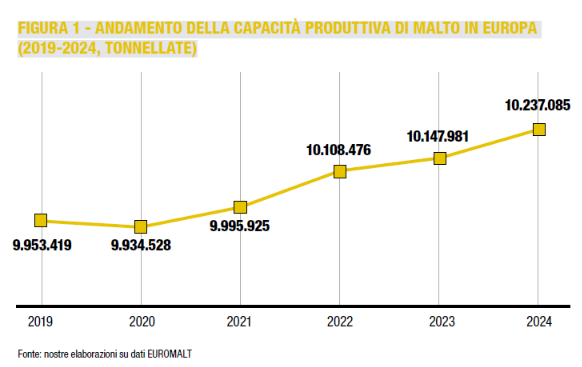
The European malt industry landscape between 2019 and 2024 reveals a market characterised by solid stability, with moderate growth over the period in question (Figure 1). Looking at the overall figures, in 2019 Europe had a production capacity of just under 10 million tonnes, which saw a slight decline in 2020 due to the restrictions imposed by the pandemic. However, this setback was only temporary: by 2021, the sector had already regained momentum, closing 2024 with an overall increase of just under 3 per cent compared with pre-pandemic levels.
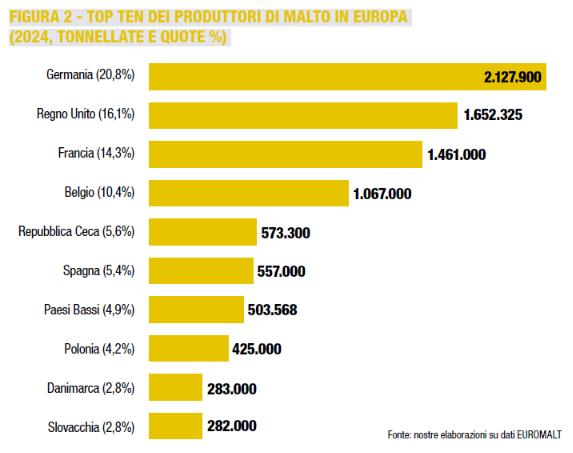
Germany remains the beating heart of the industry, with volumes exceeding 2.1 million tonnes throughout the period and a share of around 20.8 per cent of the European total in 2024. It is followed by the United Kingdom and France, which, together with Germany, form the core of the continent’s malting capacity (Figure 2).
Among the medium-sized producers, varying trends are evident. Belgium enjoyed an exceptional 2024, exceeding the symbolic threshold of one million tonnes for the first time during the period under review. Ireland, on the other hand, whilst starting from lower volumes, recorded particularly significant percentage growth, rising from just 91,000 tonnes in 2019 to 170,000 in 2024 and almost doubling its production capacity over the course of six years.
Other countries, such as Poland, Spain, the Czech Republic and the Netherlands, on the other hand, show greater stability, contributing to the overall resilience of the European system. The stability observed in numerous European countries suggests that the continental malting sector is not merely a matter of large production volumes, but also the result of a complex network of national supply chains capable of adapting to economic fluctuations and changes in the brewing market.
Underpinning the sector’s substantial resilience is also the evolution of the European beer market. In recent years, the sector has had to contend with rising energy costs, the volatility of agricultural commodities and changing consumer habits, characterised by the growth of low-alcohol and non-alcoholic beers and the ongoing diversification of the beer range. Against this backdrop, malt continues to represent a strategic element for the European brewing industry, both in terms of production and in terms of product innovation.
Italian malting capacity
Within the European malt sector, Italy accounts for a relatively small share, with a production capacity in 2024 of just over 83,000 tonnes, representing less than 1 per cent of the European total. In addition to the sector’s small size, the national system continues to be characterised by a high concentration of production capacity and a limited range of special malts, factors which contribute to maintaining a high level of dependence on foreign supplies.
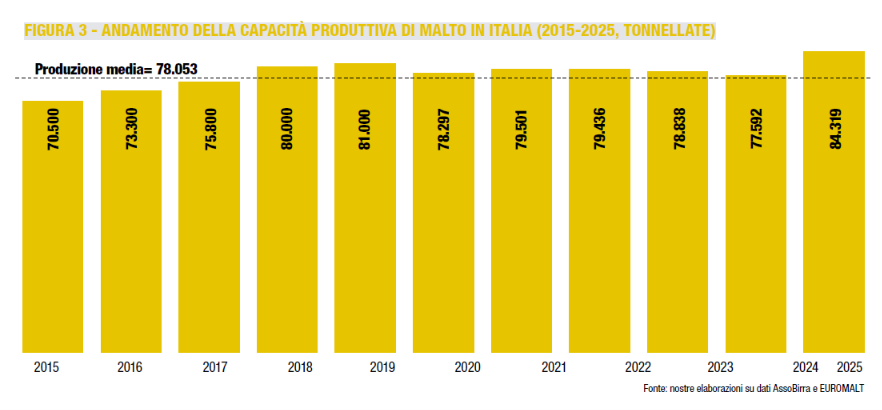
Looking at the trend over time, a fairly steady pattern emerges. Following a period of gradual growth between 2015 and 2019, when Italian malt production rose from around 70,500 to 81,000 tonnes, the sector remained largely stable in the subsequent years, despite the challenges posed by the pandemic, rising energy costs and volatility in agricultural markets. In fact, 2024 saw the highest figure in the entire series under consideration (Figure 3).
This trend suggests the existence of a national malting industry that is relatively small in scale but has been characterised by substantial continuity of production over the last decade. However, there remain critical issues relating to the ability to fully meet domestic demand, as highlighted by the growing reliance on malt imports. In this context, strengthening relations between malting plants, breweries and specialised agricultural producers takes on particular importance, especially within brewing supply chains focused on promoting the origin of raw materials.
The distribution of malting plants in Italy
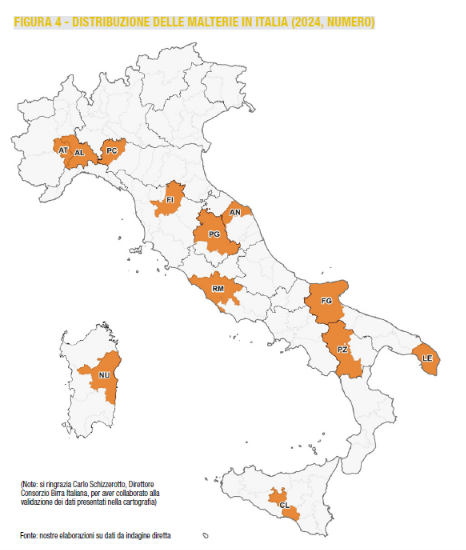
The location of Italian malting plants – including large-scale industrial production sites as well as small, medium and micro-enterprises – shows a distribution that is fairly concentrated in certain specific regions of the peninsula. The plants are predominantly situated in the central and northern regions and along certain production corridors in the south, with significant concentrations in Emilia-Romagna, Veneto, Marche, Puglia and Basilicata (Figure 4).
Rather than a uniform distribution across the country, what emerges is a production pattern strongly influenced by the presence of specialised cereal-growing areas, the availability of established technical expertise and proximity to the main processing centres. In particular, certain areas of the South, characterised by a long-standing tradition of cereal cultivation, are showing growing interest in the cultivation of malting barley. This trend can be attributed both to the long-standing expertise in cereal farming and to the search for crops capable of guaranteeing higher returns compared to other traditional cereal crops. Furthermore, an analysis of the geographical distribution highlights the high concentration of national production capacity amongst a small number of industrial operators, whilst initiatives developed within the artisan supply chains still represent a limited and restricted component of the sector.
This paper was produced as part of the LOB.IT project (Masaf, Ministerial Decree No. 667550; 30 December 2022)