In Stabio, a municipality in the Canton of Ticino, just a few kilometres from the Italian border – 3 from Gaggiolo (VA), 8 from Brogeda (CO) – and a stone’s throw from the motorway junction leading into the Swiss interior, S.A. Vini Bée has enjoyed three years of rapid growth. A production area of 1.350 square metres, 40 employees across the factory, the Lugano and Lucerne retail outlets, administration and sales, and an annual output that has risen from 5 million to over 7 million bottles of wine, bottled under the company’s own brand or for third parties: figures that tell the story of a company undergoing a major transformation, supported over the last three years by around one and a half million Swiss francs of investment in new warehouses, process technologies and the refurbishment of the bottling line. It is against this backdrop that the latest acquisition was made, arriving at the company in the early months of 2026: a new Cavagnino & Gatti labelling machine, installed to replace the previous model from the same manufacturer. This was no random choice, but the natural evolution of a relationship of trust built up over the years, which is now capable of supporting a production capacity of over 10.000 bottles per hour whilst maintaining standards of precision that are evident on the production line, bottle after bottle, format after format. This generational upgrade of the machine comes, moreover, at the most opportune moment, just as the Ticino-based company is experiencing an increase in commercial demand that has made it necessary to rethink the entire production planning for the coming months.
More precise guidelines and customised labels
Vini Bée’s bottling line 1 has now been almost entirely modernised: the depalletiser, case packer, case former and palletiser, amongst others, have largely been installed over the last four years, coordinated by a conveyor control system that automatically regulates the speed of the entire line and has marked a turning point in the process of optimising productivity, thanks to its Master and Slave functions. However, one component was missing that could match the standard of the rest of the plant. «We needed to be able to position the bottles with precision, whilst also offering third parties the option of commissioning packaging with screen-printed or customised glass – explains Marco Marotta, Production Manager at S.A. Vini Bée –, and we wanted to put a definitive end to the quality issues linked to the age of the old labelling machine, from which, obviously, we could not expect perfection». This need arose from direct discussions with Cavagnino & Gatti, a supplier already well-known to the company for the reliability it has demonstrated over time and for a support and spare parts service which, as Marotta explains, «really makes the difference today, avoiding long production line stoppages due to breakdowns or delays». This versatility was not a matter of whim: the line currently handles 15 different bottle sizes and over 100 types of labels, including self-adhesive and wet glue varieties, as well as customised labels for contract manufacturing clients – a range that the old machine was now struggling to cope with without constant stoppages and adjustments.
Inside the machine: stations, sensors, lasers
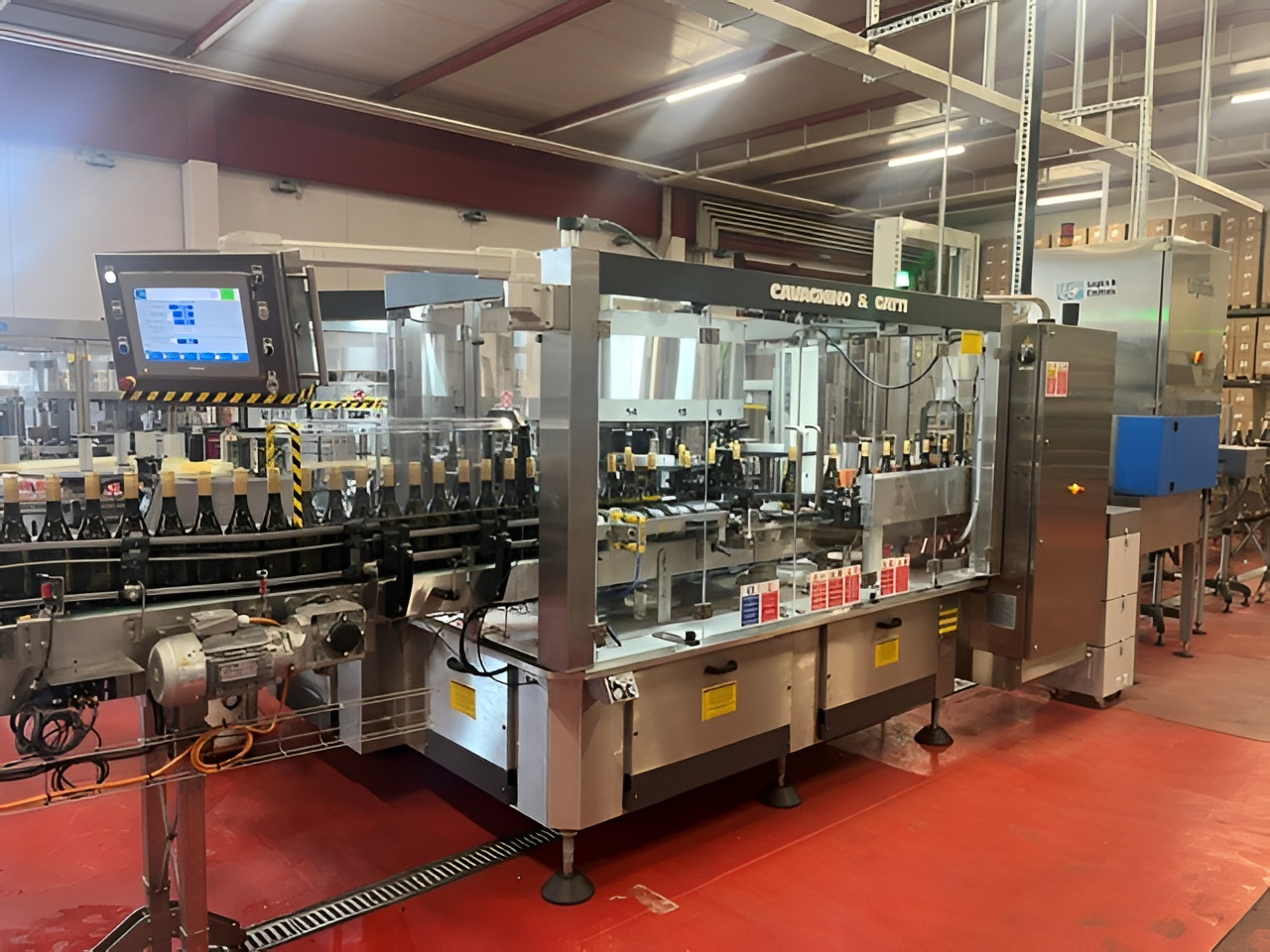
The model selected, identified by the code CG-84BL-2-22-4VPSH-SFGD-CF-6-MP, is a new-generation machine designed for the combined handling of paper and self-adhesive labels on cylindrical and conical bottles, with a stated production capacity of 11.000 bottles per hour.
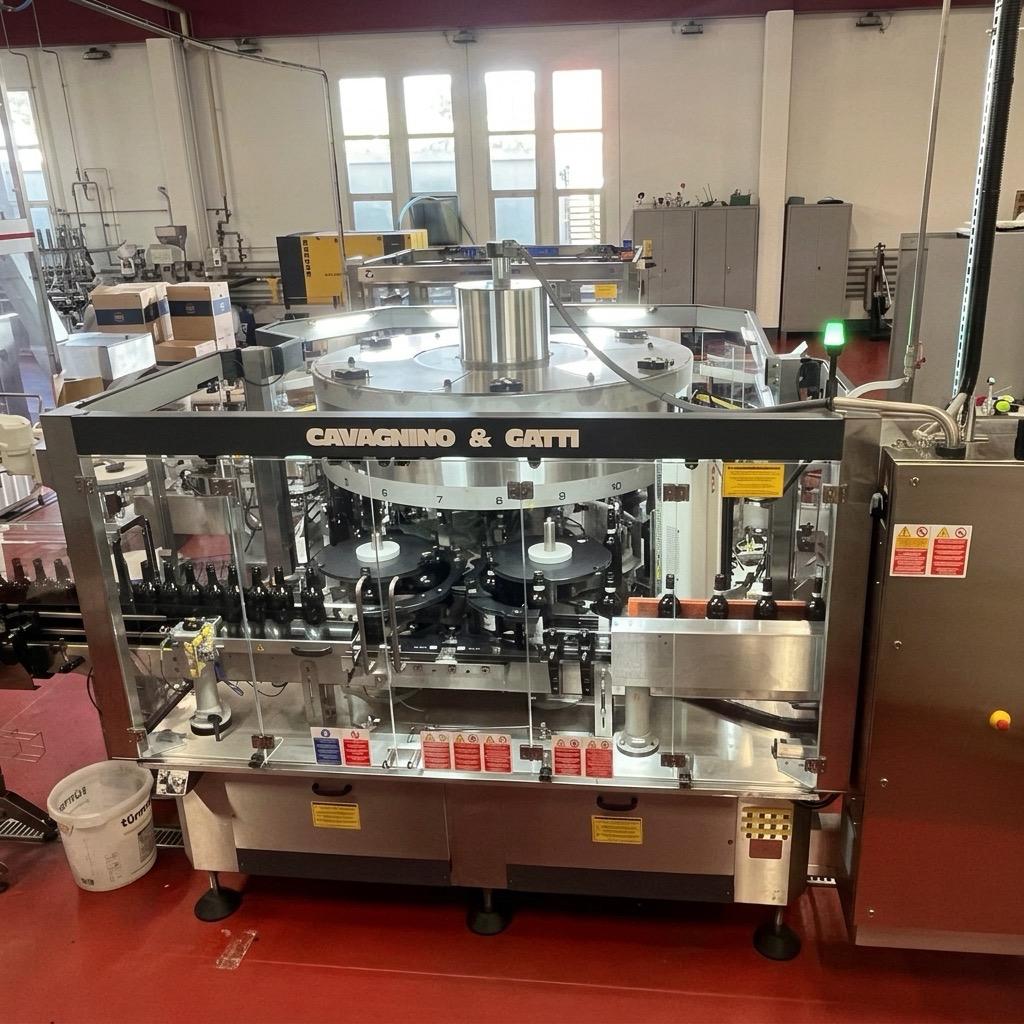
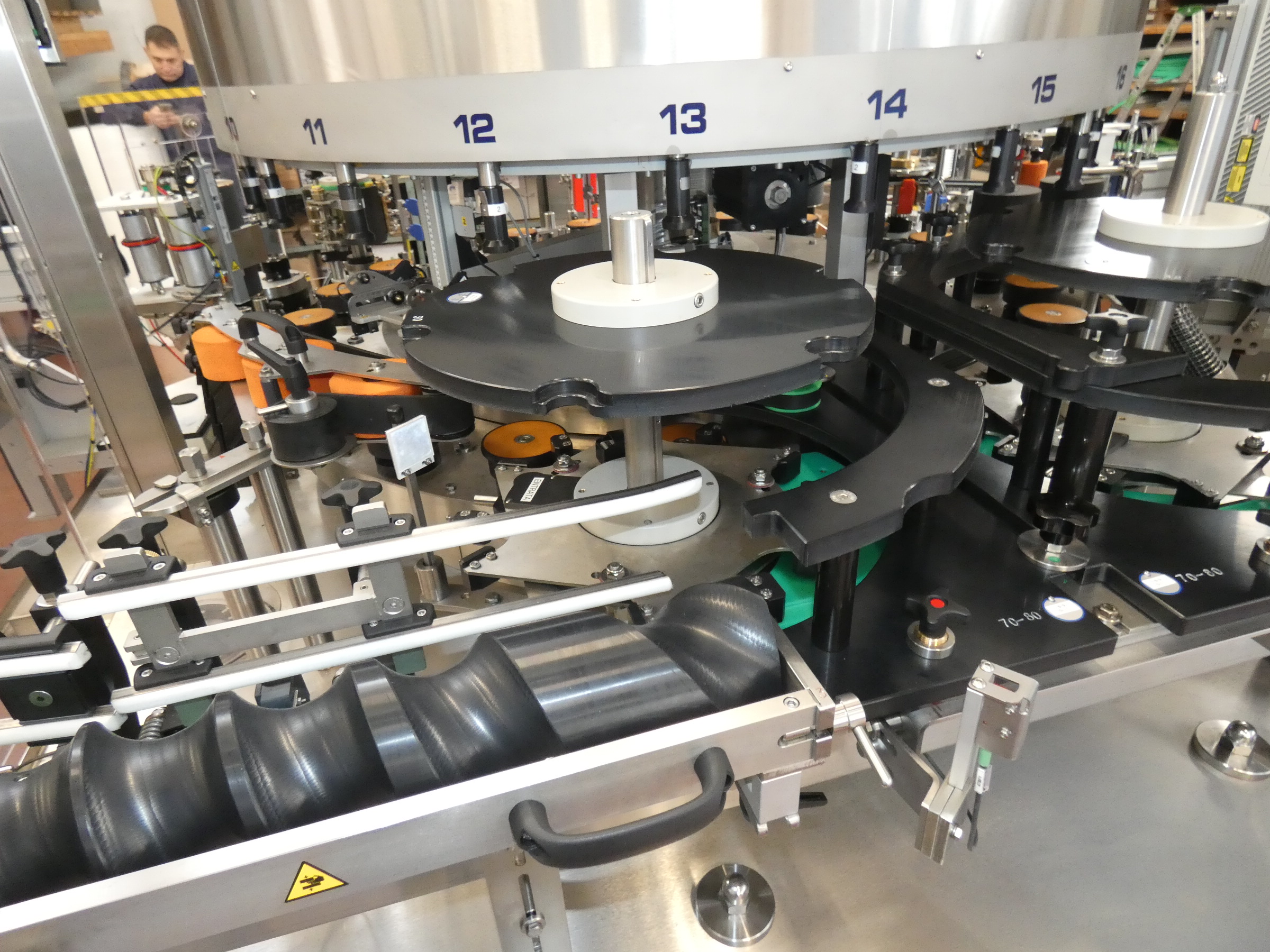
«The configuration comprises 4 self-adhesive stations and 2 wet glue stations, with 22 motorised, customisable bottle platforms for each dedicated format – explains Marco Ferracin, Sales Manager at Cavagnino & Gatti –, a level of flexibility that allows for the handling of very different formats without requiring any structural modifications to the machine». The bottles are aligned using a dual photocell system, capable of detecting the glass seam, the UV mark or the coloured mark, ensuring accurate positioning even on complex reference points; furthermore, a laser coder is integrated into the machine, which marks the daily batch directly onto glass, PET or paper, thereby improving the system’s compactness whilst ensuring consistent coding quality without the need for external systems. The motorised lifting of the carousel, with automatic positioning, reduces set-up times compared to the old system, whilst the multi-format star wheels facilitate production changeovers without the need for complex manual adjustments. Finally, the provision for remote assistance completes the picture, enabling rapid and targeted remote interventions to support production continuity. For Marotta, the leap in quality was particularly evident in the operational details: «It now takes us two minutes to set up the sensors for bottle orientation. It took just three days of testing to reach full production capacity, a result I would describe as surprising».
More bottles, fewer defects, a lasting relationship
Since the labelling machine came into operation, the line’s average daily output has increased by around 50.000 bottles, but it is in terms of consistent quality that the change is best measured. «Even at 10.000 bottles an hour, the bottles all come out identical to one another, and on the control screen the deviation of the labels is measured in tenths of a millimetre – invisible to the human», says Marotta, who also recalls an issue from the early days of use.
«A particular bottle size had caused us some difficulties, which were resolved over the phone and step by step thanks to the excellent after-sales support from Cavagnino & Gatti, which also boasts an impeccable spare parts service». Commenting on Vini Bée’s loyalty, Ferracin says: «When a customer chooses to return to us to upgrade their plant, it means that our product and service have delivered on their promises over time. In this case, the evolution of Vini Bée’s production requirements paved the way for technical discussions that led to the selection of a model offering better performance and greater flexibility than the previous one. The continuity of this relationship is the achievement we are most proud of». Prior to delivery, over 30 different packages were tested and validated at Cavagnino & Gatti, confirming the machine’s reliability and a working method that prioritises prior verification over on-the-fly adjustments. «I am proud and satisfied to have recommended the Cavagnino & Gatti machine to the owners – concludes Marotta –. At present, the new labelling machine serves as our calling card: first, we take customers to see it and show them how it works and how it handles the bottles; then, in the tasting room, we let them choose freely which products to taste, confident that no labelled item will have any visible defects».