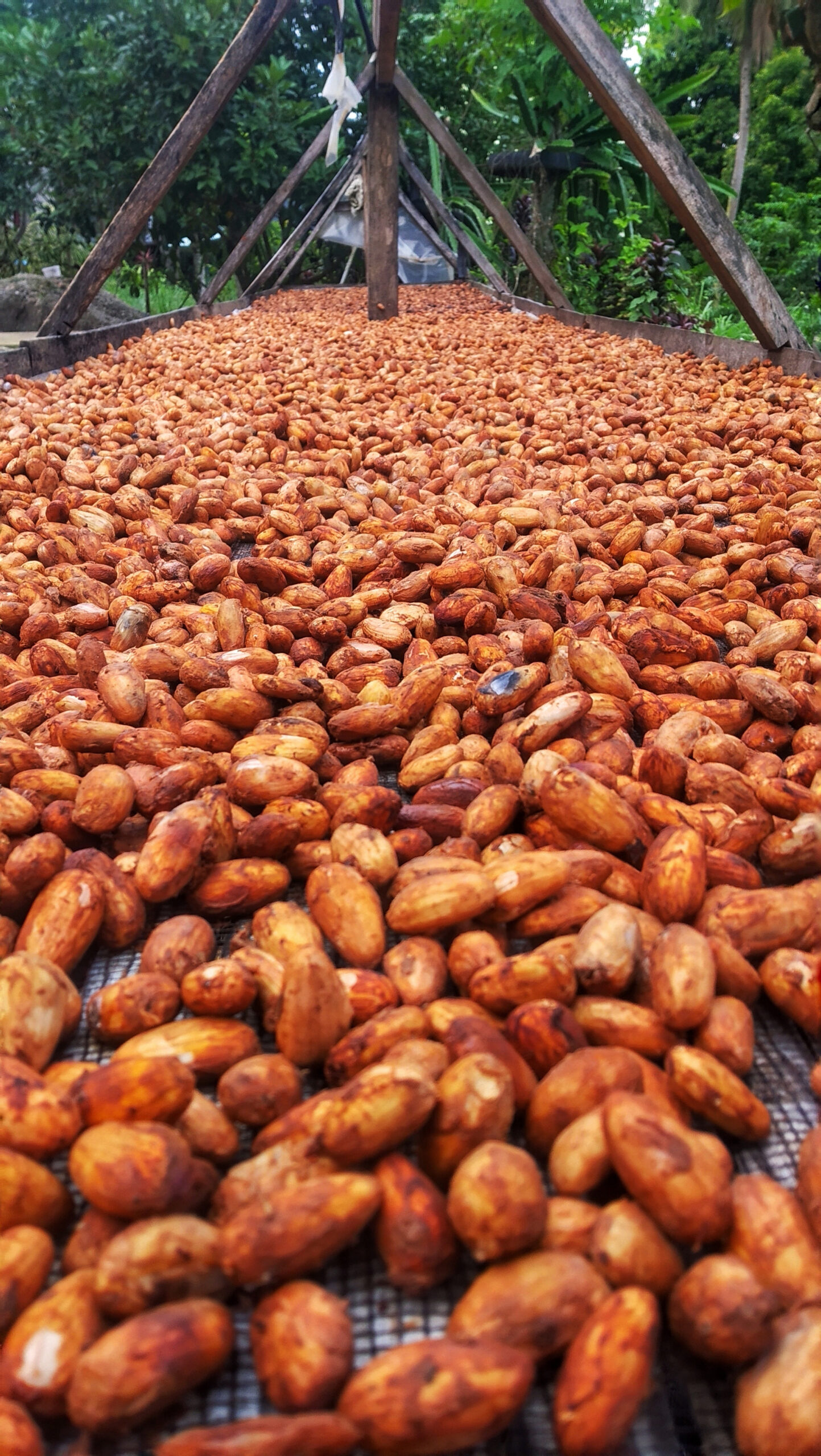
Freshly fermented and dried, cocoa beans typically exhibit:
- very intense and highly volatile fruity notes;
- less pronounced cocoa aromatic notes;
- higher acidity (particularly acetic acid);
- a range of potentially unpleasant notes (such as yeast, mold, and other unusual nuances).
It is therefore essential to store bean samples for a period of time to allow them to “age” before being transformed into liquor (paste).
Aging for a period of 6 to 12 weeks improves stability, making the samples more representative, and facilitating the “optimal expression” of the beans’ true aromatic potential. Beans must be stored in a new, clean bag, suitable for contact with food and made of a breathable material such as canvas, jute, or cotton. It is important that the bags used to store the beans are odorless, to ensure the absence of unpleasant odors or flavors during storage. It is also important that the seeds are stored carefully and in conditions that prevent them from being damaged by mold, pest infestation, or contamination from other samples or substances that could alter their flavor or, in extreme cases, pose a health risk. During this short storage period, the physical quality of the beans can be assessed by cutting them to visually observe the fermentation process and the condition of the seeds.
Roasting the champions
There are many options available for roasting samples for laboratory flavor testing. These include:
- static tray roasters, such as countertop ovens and home ovens;
- small rotary roasters, such as “converted rotisserie ovens”;
- unvented laboratory chamber ovens;
- mechanically ventilated convection ovens;
- high-efficiency convection ovens.
In these different roasting options, heating systems range from electrically heated elements to infrared heaters, with or without air or fan control, but with temperature and timer settings; temperature and time control are the minimum required. To achieve the optimal roasting method, critical factors must be identified and standardized. These factors generally include:
- Thermal uniformity of airflow throughout the oven cavity, both empty and fully loaded.
- Recovery time from door opening to set point.
- Airflow movement through a circulating fan.
The roasting trays on which the cocoa beans are placed should be made of coarse-mesh stainless steel (preferred) or untreated mild steel, with meshes small enough to prevent the beans from falling out but large enough to promote optimal airflow over the beans. Rotary ovens should have drums with mesh or uniform perforations, excluding “solid” drums, which are never recommended. Loading and unloading operations should be as simple as possible to allow for complete product unloading and effective equipment cleaning; these factors ensure uniform airflow. Ideally, “static tray” ovens should be loaded with a single tray with a coarse mesh, and the beans should be placed in a single, uniform thickness across the loading area. To ensure that roasting is carried out with the same quantity of beans, if there isn’t enough to fill the tray, you should add additional beans to make up the required amount. This trick is limited to this type of roasting and isn’t applicable to rotary drum roasters, as they don’t guarantee a uniform load.
Roasting conditions
The key to evaluating the aromatic profile of the selected samples is the roasting conditions chosen to maximize the aromatic potential of each cocoa bean. These conditions should be mapped based on temperature, time, and load capacity for each variety and the specific roaster used. Typically, using a convection tray roaster, the following conditions are recommended:
- Trinitario variety: -120°C for 25 minutes
- Forastero variety: -130°C for 25 minutes
- Criollo Antiche variety: -112°C for 25 minutes
Time is measured starting from 2°C below the set point. These times are based on a 5-7 minute oven recovery period from the moment the door is closed at 2°C below the set point. Most newer Criollo crops are typically roasted under Trinitario conditions, as they are generally much more genetically similar.
Roasting conditions should be selected to favor the expression of Trinitario’s intrinsic secondary fruity and floral aromas, while preserving Criollo’s delicate hazelnut/caramel notes. Roasting conditions for Forastero, on the other hand, should aim to bring out all the secondary aromas, as well as the maximum cocoa/chocolate flavor that are the foundation of this variety.
Before roasting, both bean size and moisture content are important for flavor evaluation; for flavor assessment, samples with very low (<6.5%) or very high (>8.5%) moisture content may require adjustment of roasting conditions to ensure standardization. Similarly, before roasting, beans may need to be sorted based on size. As long as bean size is between 70 and 130 beans/100 g, adjustments to roasting conditions should not be necessary.
Separation and screening
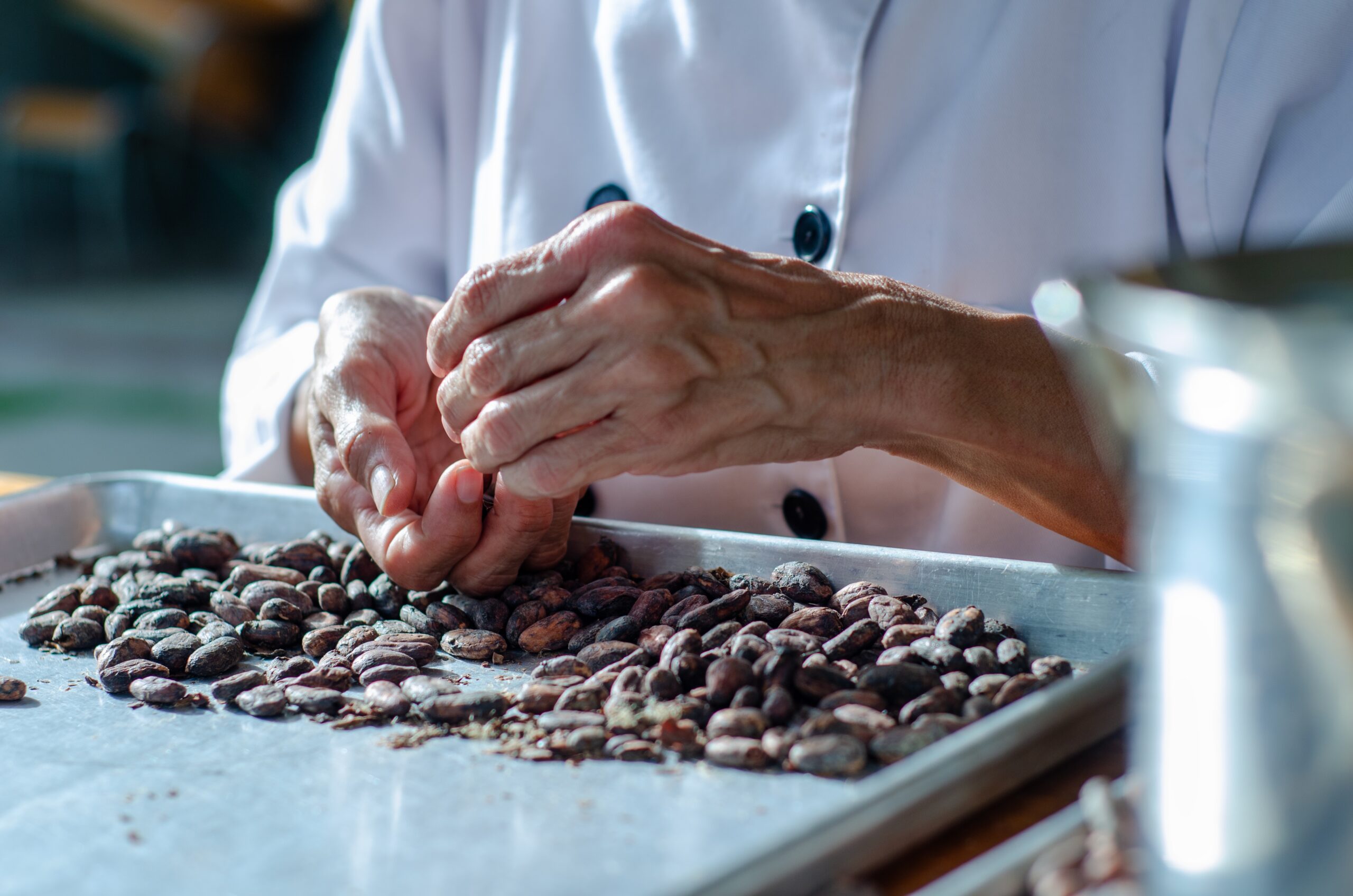
Optimal fermentation and roasting directly impact separation and screening performance. Poorly fermented beans roasted at low temperatures tend to have a hull that adheres tightly to the inside and, consequently, to the kernel, making separation and screening difficult. Both operations should take place immediately after cooling the beans after roasting (usually between 20 and 60 minutes) for efficient separation and to ensure that unwanted aromas from the environment are not absorbed. Cooling to room temperature can be done simply on a raised rack, perhaps even using a small fan to accelerate the cooling process. It is important to remember, however, that the area in which sample preparation is carried out must be odor-free. It is important to note that, before roasting, beans should be treated as a raw agricultural product and therefore may be contaminated by a large number of microorganisms, including pathogens. Roasting conditions should ensure the elimination of pathogens, but, to be safe, samples should be checked for their presence before sensory analysis. It is therefore essential to take precautions to prevent cross-contamination between raw and roasted beans, which should be part of an active HACCP program, to ensure the wholesomeness of all products tasted. When only a few samples are to be analyzed, breaking and sifting can be done very simply: place the cooled beans in a high-quality, airtight bag, remove as much air as possible, and crush them lightly with a rolling pin or similar tool. A household hair dryer can then be used to remove the skins from the beans on a tray (plate) in a well-ventilated area. A larger quantity of samples intended for flavor evaluation will certainly require at least a mechanical sifting system. Industrial screening systems include mechanisms to adjust airflow based on nib/husk particle size (a “grading” process) to optimize skin separation. Mechanized cocoa screeners and separators are available on a laboratory scale, both individually and for individual components. However, because the crushed beans are not “size-graded,” separation is less efficient, and bean yields often hover between 62 and 78% of the initial raw beans. This is an important consideration when planning the quantity of beans needed for the roasting process to meet the volume required for flavor assessment. Screening is generally less efficient in laboratory systems, so it is recommended to manually remove—perhaps with simple tweezers—the skin residue from the screened beans (including both loose and still-adherent skin fragments) to reduce their content to zero. This ensures low contamination from skin residue, with the added benefit of producing infusions with much lower levels of microbiological contamination (i.e., extremely low total bacterial counts/standard bacterial counts), since most microorganisms reside on the husk.
Because cocoa beans absorb both environmental humidity and any undesirable aromas present in the environment, cocoa beans should be stored after screening, both before and after manual harvesting, in airtight containers or in (high-quality) snap-lock bags suitable for food contact. Furthermore, knowing that cocoa bean samples deteriorate rapidly, it is recommended to make every effort to transform them into liqueur within 48 hours of roasting. If necessary, cocoa bean samples can be stored for up to seven days at a temperature between 10 and 24°C in sealed bags.
References: 1) Cocoa Beans, Chocolate and Cocoa Industry Quality Requirements (Caobisco 2016). 2) Ernesto G. Carrega, Cacao, cioccolato e affini (PVI 2019).