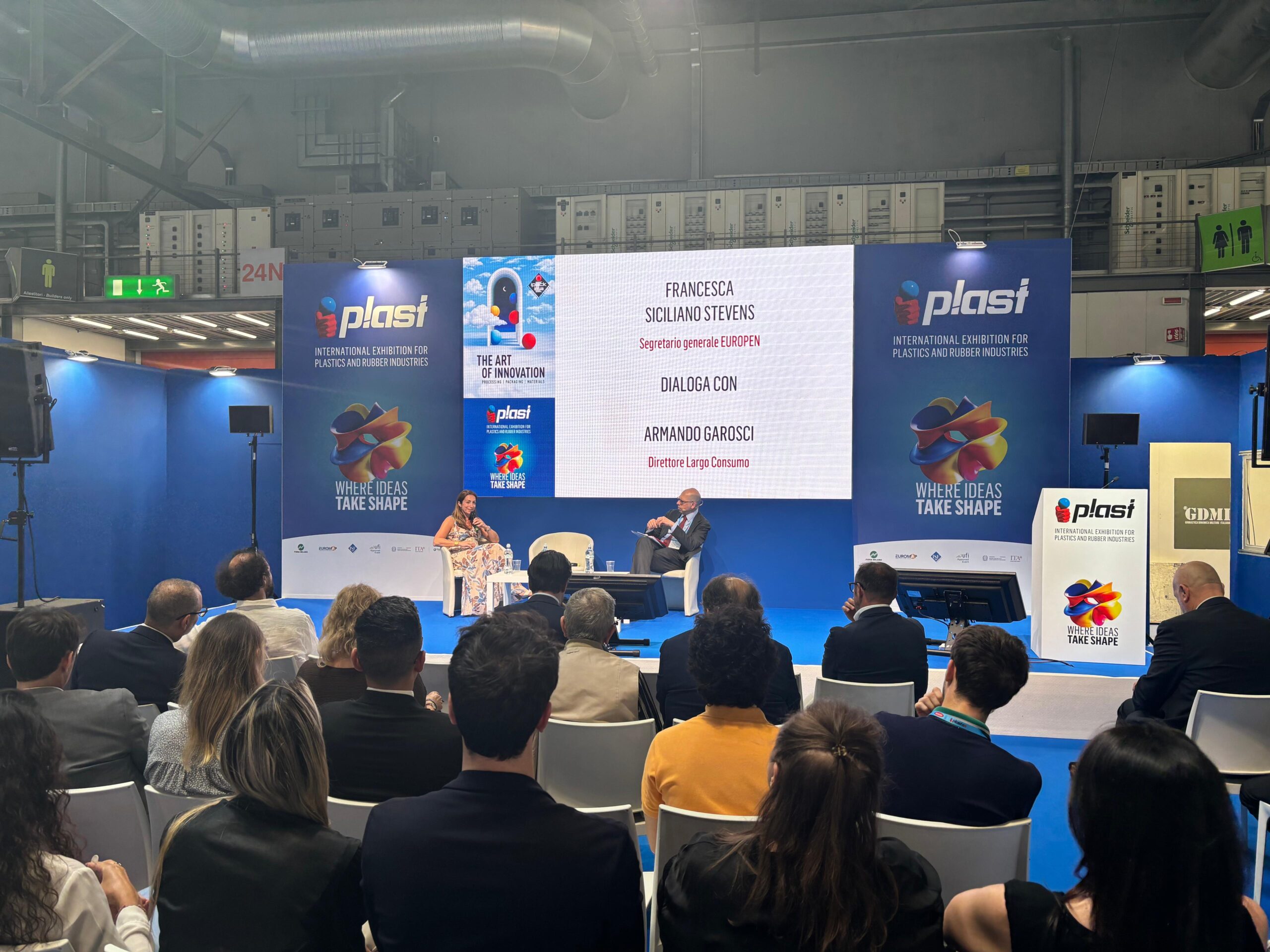
Yesterday, at Plast, the international trade fair dedicated to the plastics and rubber industry, which is taking place at Fiera Milano from 9 to 12 June, the conference “Plastic: public enemy or designated victim?” was held, promoted by the Technical Scientific Committee (CTS) of IPACK-IMA in collaboration with Largo Consumo.
A discussion that brought together industry associations, research centres, large retailers and brand owners to address the sector’s key issues: regulatory pressures, the circular economy and the role of plastic in packaging.
According to data from the Ipack-Ima – MECS Observatory, in 2025 the global production of plastics reached 375 million tonnes, while global consumption recorded a value of 368 million tonnes; both are expected to grow by an average of 3.1% per year until 2029. In the packaging sector, of the global volume of 4,489 billion pack units, as many as 2,767 billion are plastic packaging, divided respectively between Flexible Plastic (1,439 billion pack units) and Rigid Plastic (1,328 billion pack units). On the environmental front, global municipal waste amounts to 2.1 billion tonnes, of which 400 million tonnes are plastic (19%) and 160 million are attributable to packaging.
It is in this context that the IPACK-IMA conference takes place: a discussion between those who interpret the rules, those who apply them and those who put plastic on the shelves every day. At the table, moderated by Armando Garosci, director of Largo Consumo, were leading speakers, including Europen, the voice of European packaging on regulatory tables, UCIMA‘s MECS Research Centre for market analysis, and the packaging managers of Esselunga, Henkel and Noberasco.
“When it comes to plastic in packaging,” reads a note from IPACK-IMA, “the public debate often oversimplifies, turning a material into a defendant. Yet plastic remains irreplaceable: it extends shelf life, protects food and pharmaceutical safety, and reduces waste. Because the real game will not be played on the defence or condemnation of a material, but on the ability of European manufacturing to innovate before the regulations impose it”.