The use of soft robotic grippers in the food industry is an increasingly exciting topic, but their widespread use in industrial practice is still limited. Handling unpackaged foods is much more complex than handling pre-packaged products. Food can be fragile, moist, irregular, deformable, or change behavior based on temperature, ripeness, and processing conditions. For this reason, developing truly reliable, hygienic, and easily integrated soft grippers into production lines remains a significant challenge. The promise is clear: improved grip, adaptable to different products, reduced changeover times, reduced waste, and more flexible automation. However, there is still a gap between research, prototypes, and large-scale industrial applications. In recent years, many manufacturing industries have introduced robotic systems to increase efficiency, quality, and production continuity. The advantages are well-known: greater speed, less variability, reduced repetitive tasks, and the ability to operate in harsh environments. In the food industry, however, robotic automation has followed a more gradual path. Robots are widely used in end-of-line activities, such as packaging, boxing, and palletizing, but are less common in stages requiring direct handling of the food product. The difference is substantial. It’s one thing to pick up a rigid package or box with a predictable shape and weight; it’s quite another to grasp a croissant, a soaked apple, a portion of fish, or a piece of chicken randomly placed on a conveyor belt. In the first case, the geometry is regular and repeatable. In the second, each piece may differ from the previous one in shape, consistency, surface, and fragility. In these cases, the grip may become unstable, difficult to repeat, or even damage the product. Designing a specific gripper for each food product would be possible, but impractical: it would increase costs, format changeover times, maintenance, and operational complexity.
Food automation and the challenges of robotic gripping
One of the main limitations of food automation is the difficulty of matching the flexibility of a human operator. A human can adapt their movements naturally: they assess the consistency of the product, correct their grip if the object slips, adjust the force, and can handle overlapping or irregularly arranged foods. For a robot, however, these operations require much more advanced vision, control, and gripping systems. This does not mean that robotics lacks great potential in the food industry. On the contrary, the benefits are significant. An automated system can ensure operational continuity, repeatability, error reduction, and improved hygiene. This latter aspect is particularly relevant for ready-to-eat products or those intended for simple reheating, where microbiological contamination can pose a significant risk. The difficulty of food handling is not new. Early studies on kitchen and food preparation automation revealed that gripping, dispensing, and positioning were among the most critical points. A landmark example is Patri’s 1991 work, which involved using a Puma 760 robot to serve dishes according to preset recipes. Although it was a theoretical project, it already highlighted the complexity of handling food with simple, generalizable technical solutions. The problem remains relevant today, and the availability of flexible gripping devices continues to be one of the main obstacles to the widespread use of robotics in the direct handling of unpackaged foods.
From research to industrial applications
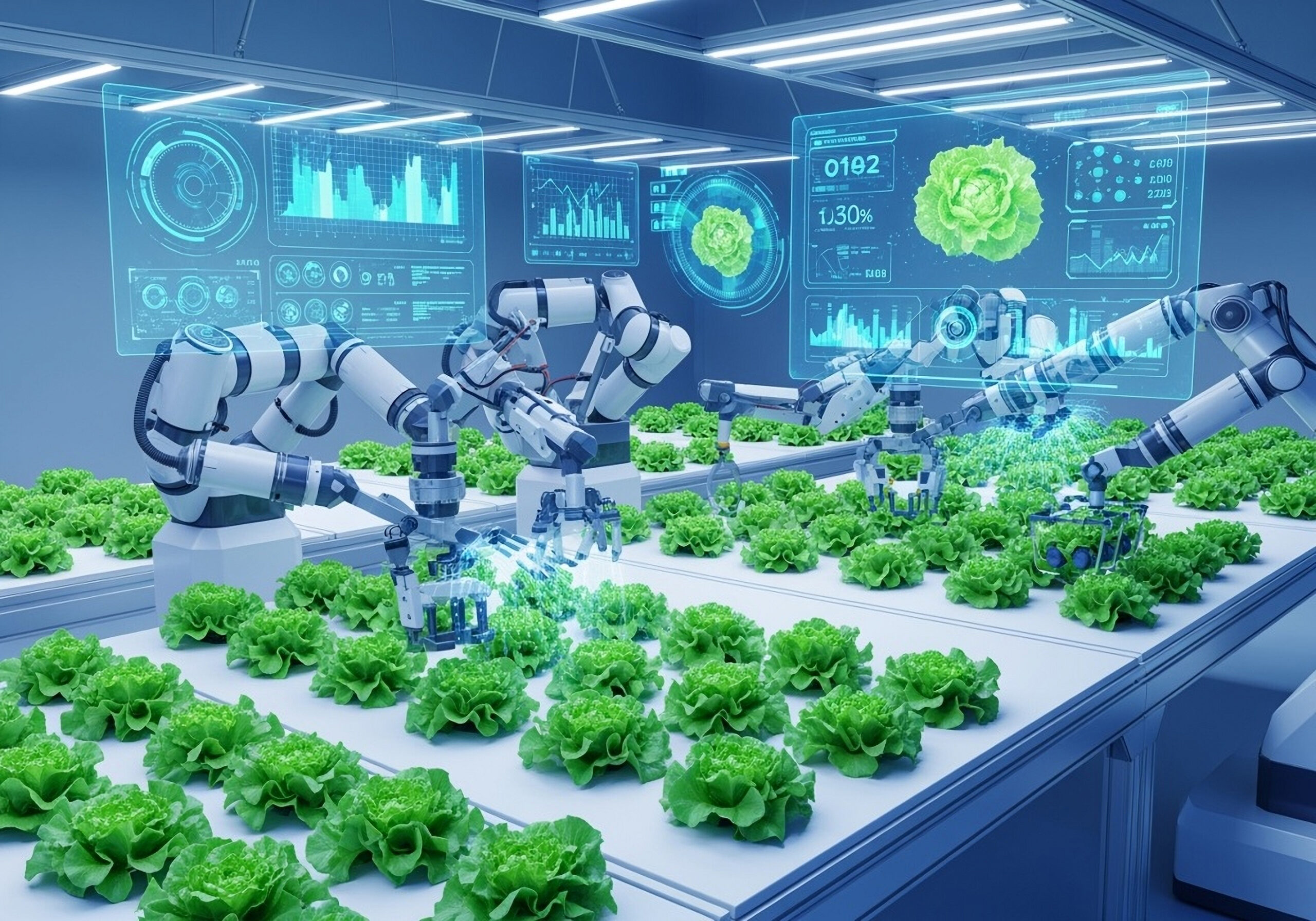
Soft robotics represents one of the most promising ways to overcome the limitations of traditional grippers. Soft grippers can deform, adapt to the shape of the product, and better distribute gripping force. This makes them suitable for pick-and-place, portioning, packaging, and handling bulk or irregular products. Available solutions can be divided into several categories.
One of the most common is suction grippers. They are compact and require contact with only one surface of the product. They work well with smooth and fairly stable foods, but can lose effectiveness in the presence of irregular geometries, porous surfaces, moisture, or surface liquids. In these cases, the vacuum seal can become unstable and compromise grip repeatability. To increase reliability, vacuum is sometimes combined with soft elements or flexible fingers. This gives rise to hybrid systems, more adaptable to the shape of the food. These systems can improve versatility, but also introduce new complexities: more components to clean, greater attention to hygienic design, and more adjustments to manage. A second approach is represented by wraparound grippers. These grippers partially or completely surround the product, distributing the force over a larger surface area. They are suitable for rounded or fairly regular products, such as tomatoes, apples, eggs, citrus fruits, or some baked goods. The advantage is a more delicate grip than rigid grippers. Their limitations arise when the product’s shape changes significantly or when the surface is slippery: in these cases, a precise balance must be found between adaptability, applied force, and risk of damage. Soft finger grippers are also very popular. In these cases, multiple flexible elements are arranged in different configurations based on the product being handled. Parallel configurations can be suitable for elongated or cylindrical products, such as bananas, cucumbers, or eggplants. Radial or centered configurations are more effective with spherical or irregular products, such as apples, oranges, kiwis, or baked goods. Finger grippers can also be used for more complex foods, such as noodles, portions of meat, fish, or ingredients intended for packaging. In these cases, the challenge is not just to grip the product, but to do so without breaking, crushing, or altering its appearance. Actuation systems can be pneumatic, tendon, magnetic, or hybrid, depending on the required force, cycle speed, and the line’s hygiene conditions.