An empty glass bottle can follow one of two paths: it can be sent for material recycling, or it can be reused as a container. In the latter case, between collection and refilling, washing becomes an essential step to ensure the bottles are once again fit for use. This is the focus of AKOMAG, a company specializing in the manufacture of washing machines for glass bottles and three- to five-gallon PET containers. “Our core business is washing glass bottles—a process primarily intended for bottles destined for reuse, though it is also applied to new glass when the production process requires more comprehensive treatment than a simple rinse,” explains Mattia Spotti, one of the company’s two owners. From his vantage point, the reuse market varies significantly across different countries and sectors. These variations influence the demands placed on manufacturers, affecting plant dimensions, container specifications, treatment cycles, and the level of support required. Consequently, production is based on a foundational model that is then adapted to the specific requirements of each individual application.
A common foundation, different configurations
“We have four or five base models. From that foundation, the configuration requested by the client takes shape. Factors such as the types of bottles, the required production output, the specific functions needed, and the capital the user intends to invest all come into play”, Spotti continues.
Customization also extends to solutions designed to reduce consumption and enhance performance. The commercial proposal outlines the equipment used to complete the machine, tailored to the user’s specific objectives. In this way, efficiency is integrated into the design of the process and the selection of the configuration—well before installation takes place. For those managing bottling operations, this means carefully defining the operating conditions under which the bottle-washing machine will function. Identifying the right model initiates a discussion regarding the containers, the treatment process, and the organization of production. Even within the same family of machines, varying requirements can lead to different solutions. The design process must account for the production system as a whole; the material of the container, the frequency of returns, and the continuity of service all help define the machine’s function and the conditions under which it must operate.
Washing as part of the production line
For a bottle that has already been used, the treatment must address the remnants of its previous lifecycle, including labels. Spotti describes a process based on immersion in baths of water and detergents, with careful control over dosage, temperature, and dwell time. These parameters must be defined according to the specific treatment required before the container moves on to the filling stage. Washing may also be necessary for new bottles, particularly when the characteristics of the product to be bottled demand a more thorough treatment of the container than a simple rinse. The bottle-washing machine thus functions as a process unit within the production line. Its role is to prepare the container for the next stage, with a configuration tailored to the specific requirements of the line. While hourly capacity is one factor to consider, it is not the only criterion for defining the system.
Growth also comes from the workshop
Taking on larger-scale projects has required AKOMAG to evolve its organizational structure. Spotti describes a journey that began with a focus primarily on small and medium-sized clients, later expanding to include orders from larger corporate groups. “We serve both small and large clients; naturally, their requirements differ“.
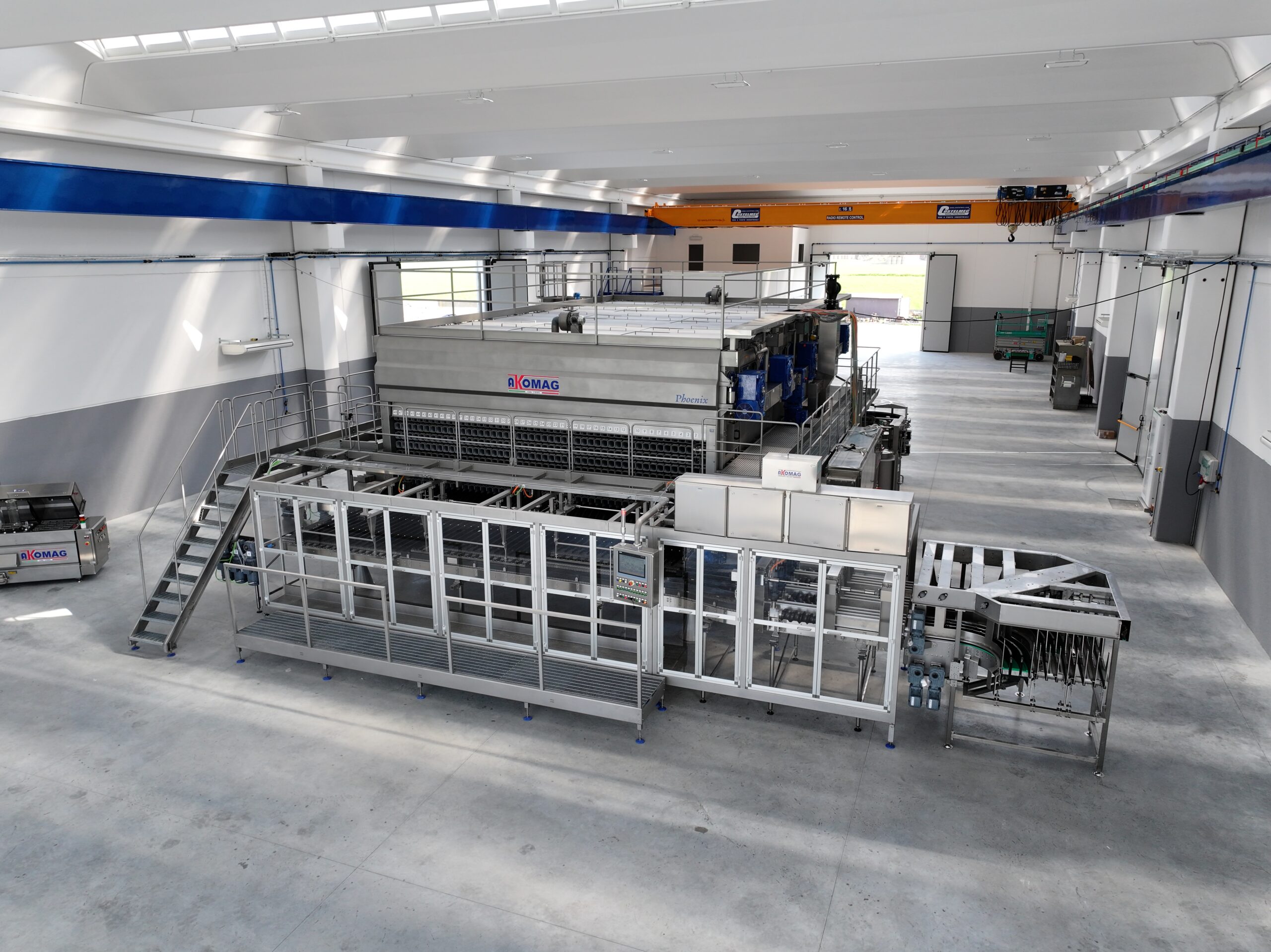
It is precisely for this reason that, in July 2026, AKOMAG inaugurated a new production facility.
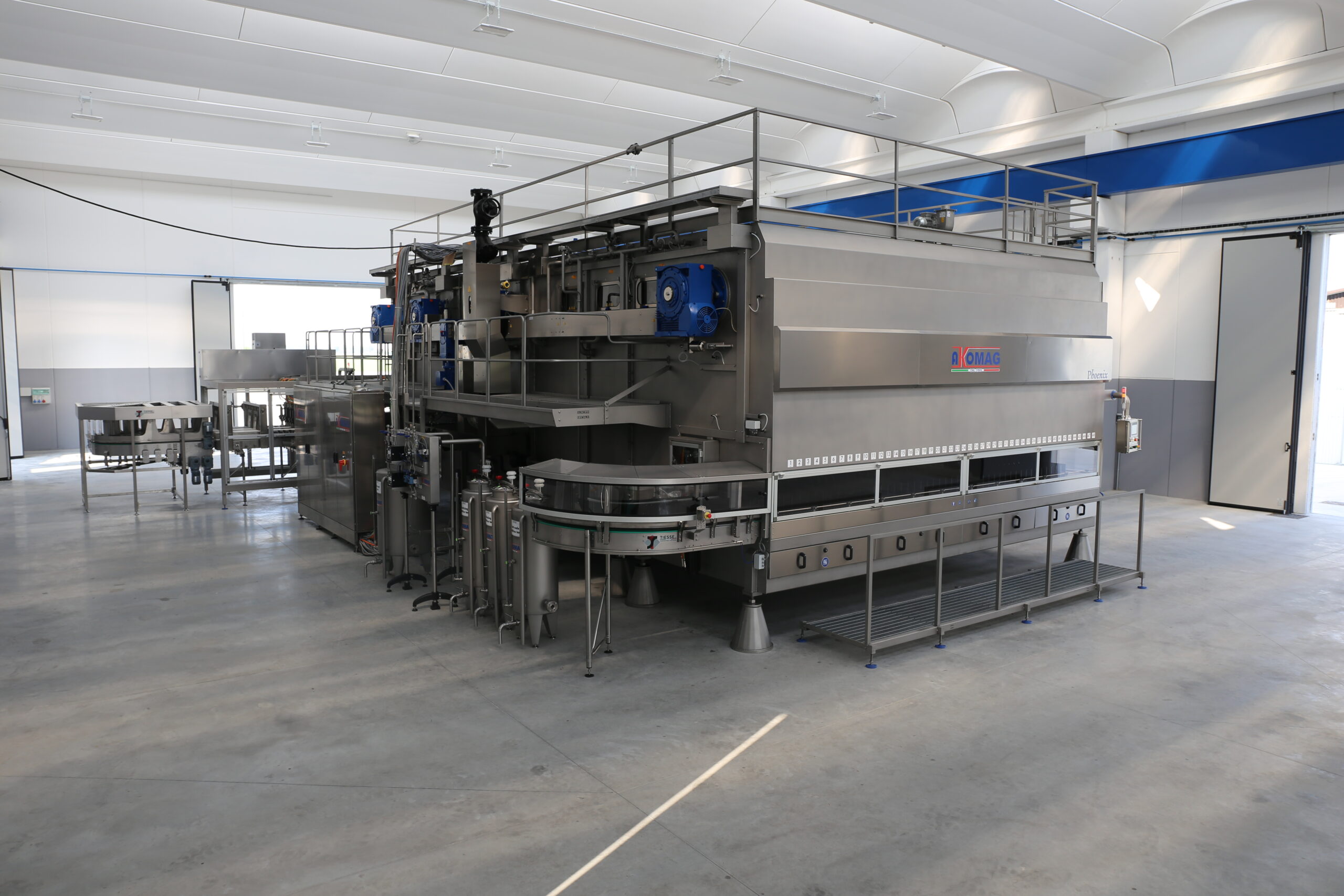
This expansion provided an opportunity to reorganize production phases, separating metal fabrication work from final assembly and testing activities. “The initial stages of construction take place in the original facility, followed by micro-peening—a process used to refine the stainless steel finish. The new space is dedicated to the final completion of the machines and subsequent testing.” Most of the machine construction is carried out in-house, starting from raw sheet metal. The process concludes with testing—typically conducted alongside the client—followed by preparation for shipment once approval is granted.
The expansion therefore addresses both the need for more space and the requirement for a more clearly defined workflow. Building larger machines involves the entire workshop, encompassing material handling, assembly, quality checks, and the coordination of personnel.
Skills to develop
AKOMAG currently has a workforce of about twenty people. The availability of personnel is one of the critical challenges in the company’s growth trajectory. The firm seeks individuals to train and integrate into its operations, yet it faces difficulties in finding them. Spotti attributes part of this problem to a shortage of young people with technical training—a particular issue in a region where the food and packaging industries have a high demand for such skills, yet the curricula offered by educational institutions do not always align with these needs.
Conversely, the entrepreneur highlights the importance of staff retention. For a company that builds customized machinery, having a stable team helps preserve accumulated expertise regarding manufacturing processes, assembly, and the specific challenges encountered across various applications. Furthermore, this technical knowledge must extend beyond the workshop; technicians frequently travel to handle installations, commissioning, and maintenance. Given the company’s international client base, it requires personnel capable of working on-site, interacting directly with the equipment and the end-users’ operators.