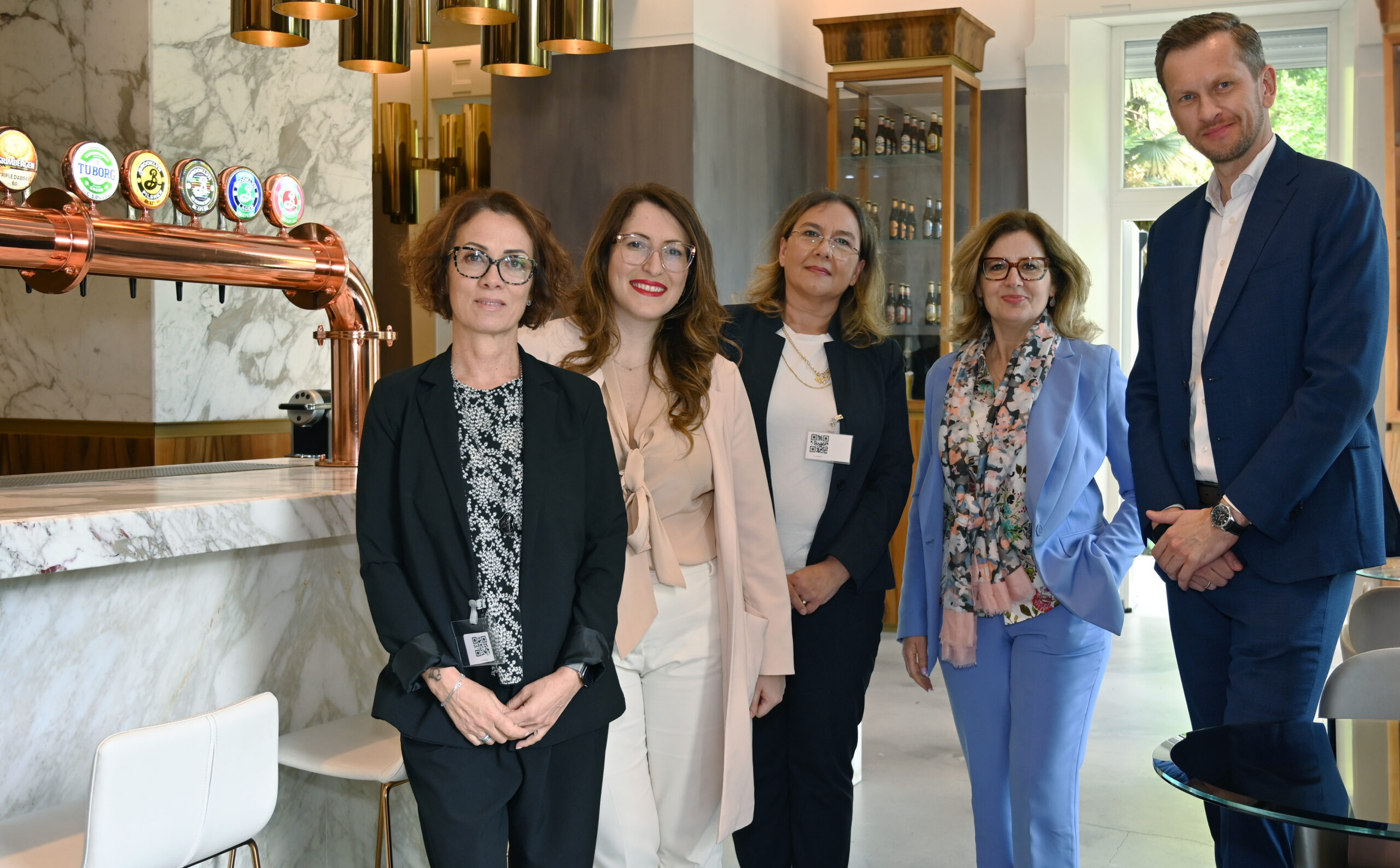
To mark National Made in Italy Day, Carlsberg Italia hosted a talk at the Birrificio Angelo Poretti on innovation and the role of raw material research for the Italian brewing industry.
The event brought together institutions, academia and research, young people and industry, with the aim of fostering a meaningful discussion on the challenges and opportunities facing the Italian brewing sector, which generates shared value of over €10 billion and employs more than 100,000 people.
Alius Antulis, Managing Director of Carlsberg Italia, highlighted the role that innovation plays in a company like Carlsberg Italia, which is global yet also deeply rooted in Italy through the Birrificio Angelo Poretti: “For us, ‘Made in Italy’ is not just a tradition; it represents a daily commitment to quality, innovation and an increasingly sustainable supply chain. Our Birrificio Angelo Poretti is an example of how a history and a tradition spanning almost 150 years can continue to evolve today, thanks to the ability to innovate, conduct research and look to the future. Through this talk, we aimed to foster an open dialogue on issues that are becoming increasingly strategic for the sector, emphasising the need for strong collaboration between industry, institutions and universities in order to build an increasingly competitive and sustainable supply chain”.
At the heart of the talk is the crucial role of research and innovation applied to raw materials, a key driver for generating value throughout the beer supply chain and making the sector increasingly competitive: indeed, the sector is currently facing complex challenges – from sustainability to new consumer demands – which require strong collaboration between companies, institutions and academia. Also playing a key role in this discussion is the central ingredient of hops, which is seen not only as a crucial component in beer production but also as a symbol of a business approach that prioritises research, the agricultural supply chain and collaboration.
In this context, Carlsberg Italia once again proves to be an innovation hub for the entire Group: consider, for example, the role it has played in developing proprietary technologies such as DraughtMaster, the innovative dispensing system tested and launched in Italy, which improves product quality, efficiency and sustainability. At the global level, this commitment translates into tangible investments: in 2025, the Carlsberg Group allocated more than € 20 million specifically to research and development, confirming the central role of innovation processes in the company’s strategy. This approach is rooted in the long-standing tradition of the Carlsberg Laboratories in Copenhagen, pioneers of key innovations for the industry, such as the discovery of the first pure strain of bottom-fermenting yeast and the invention of the pH scale: to this day, this centre of excellence remains an international benchmark for scientific research worldwide.
Senator Gisella Naturale also spoke during the talk, stating: “The brewing sector in Italy is an important industry, not least because of the close links that even the large breweries have with their local areas. The amendment to the Budget Law concerning the reduction of excise duties is the result of a long and sustained effort, which I personally led, together with my political group, to send an initial signal of support to the sector. However, to do a good job, politicians must listen to all stakeholders in a timely and consistent manner, in order to achieve a result that is widely supported and to introduce regulations that are genuinely beneficial to brewing companies. ”
Also in attendance at the meeting was Christian Garavaglia, Regional Councillor for the Lombardy Region, who stated: “Consumers’ willingness to spend more on certified quality products fuels the PDO Economy, which provides a significant boost to ‘Made in Italy’ products. PDO/PGI certification encourages investment in innovation and a commitment to creating value. The Region of Lombardy, which ranks third in Italy in terms of certified products and first in terms of agricultural area, fits into this context, regularly investing in the promotion of quality production and in academic and scientific research geared towards this objective”.
There were also significant contributions from the world of research, with Ombretta Marconi, Director of CERB at the University of Perugia, outlining CERB’s commitment to research aimed at improving the quality and adaptability of barley throughout the supply chain: “Research into barley and malt is strategic from a sustainability perspective, but also for ‘Made in Italy’: we need to study the varieties that are well suited to our regions and our climate, with a view to processing. To achieve this, we need integration between research, industry, the local area and, consequently, with the institutions, to promote sustainable production processes and Italian raw materials”.
Also present was Katya Carbone, Senior Researcher at the Council for Agricultural Research and Analysis of Agricultural Economics (CREA): “Research is the driving force behind sustainability, fuelled by knowledge and experimentation. CREA’s role is to transfer expertise to practitioners to encourage informed, long-term decisions. With regard to hops grown in Italy, the link between the field and post-harvest is fundamental: the quality of the hops depends, in fact, on a supply chain that must be flawless at every stage”.
In light of the close ties between Carlsberg and Denmark, its country of origin, Francesca Zaccarelli, AgriFood senior expert at the Danish Embassy, also took part in the discussion. She emphasised how innovation and research can transform the agri-food sectors and how it is strategic for Denmark to support Italian excellence, fostering exchanges for a more sustainable future and, consequently, more sustainable and ethical beer.
The discussion was moderated by Serena Savoca, Marketing & Corporate Affairs Director at Carlsberg Italia, who emphasised: “Today, innovation means rethinking the entire supply chain, from agriculture to the final product that reaches the consumer. In an increasingly challenging global context, the ability to integrate research, expertise and collaboration between different entities becomes a key factor in creating lasting value and shaping the future of the Italian brewing industry”.