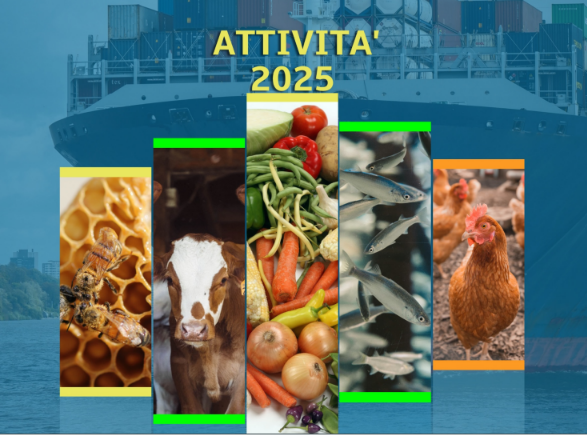
The Ministry of Health has published the 2025 report on the activities of Border Control Posts (PCF) and Veterinary Offices for Community Compliance (UVAC).
The report shows that in 2025, the ItalianPCFs, which are set up to check consignments of animals, products of animal origin, food of plant origin, feed and FCMs imported into the European Union from third countries, checked 48,480 consignments of animals, products of animal origin and feed of animal origin from over 100 third countries for import into the national territory, an increase of11.3% compared to the previous year. When deemed appropriate by the veterinary inspectors, or in compliance with specific ministerial or EU instructions, the physical inspection was supplemented by a laboratory test. The average percentage of laboratory checks compared to the total number of consignments subjected to physical checks was 7.2% in 2025, slightly higher than in 2024 (6.8%).
Rejections totalled 256 consignments of goods (approximately 0.5 per cent of the total, a percentage slightly higher than that recorded in 2024 (0.3 per cent)). With regard to the type of check (documentary, identity, physical, laboratory), rejections due to other reasons and documentary deficiencies were the most common: 22.66% were the result of documentary checks, 58.2% for other reasons, 11.33% following physical checks, 1.95% following identity checks and the remaining 5.86% following laboratory checks.
Also in 2025, Italian border control authorities inspected 231,966 consignments of food and feed of plant origin and Moca for import into the country. The average percentage of laboratory inspections relative to the total number of consignments subjected to physical inspection was 84.5 per cent.
Rejections, totalling 354 consignments, accounted for approximately 0.15 per cent of the consignments presented for import. In terms of the type of inspection (documentary, identity, physical, laboratory), rejections caused by positive results following laboratory tests were the most common, at 38.1 per cent, followed by those resulting from documentary checks at 28.8 per cent, other reasons at 23.2 per cent, physical checks at 8.8 per cent and identity checks accounting for the remaining 1.1 per cent.
As regards the UVACs, which are responsible for coordinating veterinary supervision and control of consignments of animals and goods from other European Union Member States, in 2025, 2,214,771 consignments of animals and goods were reported (+1.5% compared with 2024) and the number of registered operators (27,039) increased by 7.2% compared with 2024. Furthermore, 6,032 consignments were subjected to documentary and physical checks, and 3,648 of these were subjected to laboratory tests. Veterinary checks led to the rejection or destruction of 18 consignments of animals and goods that posed a potential risk to consumer health or animal health. More specifically, these comprised 6 consignments of fish and 6 consignments of poultry meat. Where possible, and where the irregularities were less serious (for example, incomplete certificates or commercial documents, incorrect identification of animals), steps were taken to rectify the situation (7 consignments).