In the world of wine, oxygen management is one of the key factors in preserving the quality and sensory profile desired by the winemaker. However, knowing the average permeability of a closure is not enough: it is equally important to ensure that every bottle of the same wine receives as uniform an oxygen supply as possible.
To meet this need, Vinventions is introducing the OVR (Oxygen Variation Rate), an indicator that measures the variability of oxygen permeability among closures from the same production batch. This parameter adds a new dimension to the assessment of closure performance and provides a practical tool for making increasingly informed choices. Because consistency is just as important as permeability.
Traditionally, one of the main parameters used to characterise a closure is the OTR (Oxygen Transmission Rate), which expresses the amount of oxygen that passes through the stopper over a given period.
The OTR makes it possible to choose the most suitable permeability for the wine and the winemaking objectives. However, the average value does not necessarily describe the behaviour of each individual closure.
Two batches with the same average OTR can in fact exhibit different levels of variability, with potential consequences for the uniformity of the evolution of the wines in the bottle.
This is where OVR comes in. Expressed as a percentage, this indicator measures the dispersion of OTR values from the mean, based on the analysis of 20 closures from the same batch. The lower the OVR, the more consistent the performance of the closures.
As Christine Pascal, Vinventions’ Oenology Director, points out: “For a producer, what matters is preserving the desired aromatic profile in all the bottles of the same wine. Consistency thus becomes a fully fledged selection criterion, on a par with average permeability“.
NOMACORC: the lowest OVR in the closure industry for greater uniformity
The co-extrusion technology used to produce NOMACORC closures ensures a high degree of structural uniformity and reproducible performance from one closure to the next.
This characteristic now has a quantitative counterpart in the OVR, which for NOMACORC stands at 6%, indicating a low degree of variability in oxygen permeability among closures from the same batch.
For wineries, this means being able to rely on greater predictability of oxygen ingress through the closure, which is particularly important when the aim is to preserve the consistency of a wine’s organoleptic profile over time.
The ability to measure and document this consistency reinforces the role of the closure as a precision oenological tool, not merely as a packaging component.
SUBR: consistency in the service of fine wines
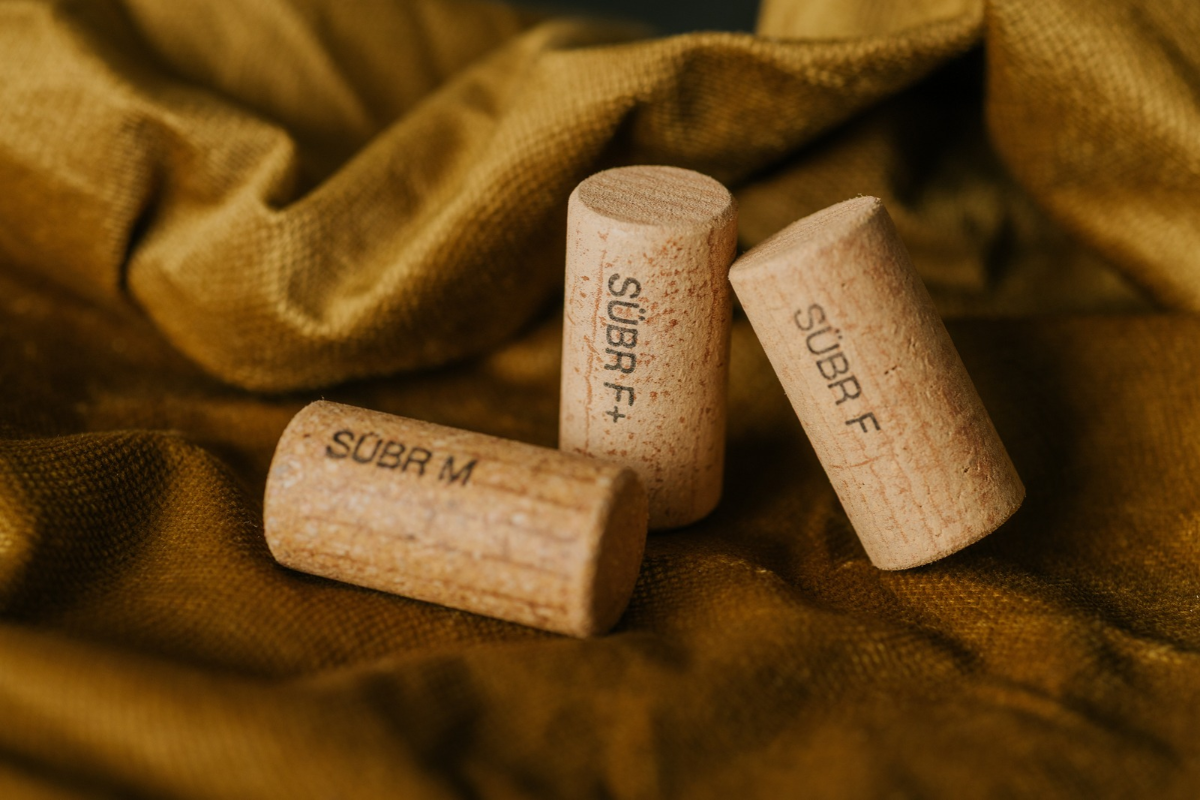
The new indicator also highlights the performance of SUBR, the range of Vinventions closures made from cork particles using an extrusion process.
SUBR demonstrates highly consistent performance, a particularly significant result for wines intended for long ageing in the bottle.
The first analyses carried out as part of the collaboration launched in July 2026 between Vinventions and Changins, the Swiss university school of viticulture and oenology, highlighted the consistency of SUBR compared with competing cork-based closures, which had OVR values 30–900% higher than SUBR.
The study, which focuses on the longevity of red wines, will continue by monitoring the evolution of the wines in the bottle over a period of five years.
The SUBR range includes closures with different levels of permeability, including SUBR M and SUBR F, with an OTR of 0.20 mg/year, and SUBR F+, with an OTR of 0.08 mg/year.
A measurement methodology developed by Vinventions
OVR is based on a measurement methodology developed by Vinventions’ research teams and published in 2011.
Using NomaSense O₂ technology, a sensor placed inside a transparent bottle allows for the monitoring of oxygen levels without needing to open or destroy the sample.
The data obtained are processed via a mathematical model that describes oxygen diffusion, making it possible to evaluate the permeability of closures and the variability within a single batch.
This methodology has been benchmarked against the Mocon reference system and enables the analysis of a larger number of closures in less time.
As Jean-Baptiste Diéval, Head of the Vinventions Certification Center, explains: “The Mocon method only allows for the analysis of a limited number of closures and requires a long stabilization phase. We have developed a method linked to a predictive model, which makes it possible to measure more closures in less time. It is precisely this method that enables the calculation of OVR“.
From oxygen measurement to performance predictability
The introduction of OVR is part of a research journey that Vinventions has been pursuing for over twenty years, aimed at deepening the understanding of the relationship between oxygen, closures, and wine evolution.
Through its NOMACORC and SUBR technologies, the company aims to offer not only varying levels of permeability but also greater insight into—and documentation of—the consistency of its products’ performance.
As Romain Thomas, Product Director at Vinventions, points out: “An average permeability figure describes a batch, not each individual closure. We are publishing OVR to assure our clients that the consistency of our closures is measured, not merely assumed“.
With OVR, Vinventions introduces a new criterion for selecting closures: it is not just a matter of how much oxygen passes through the closure, but how consistently this occurs from one bottle to the next.
This represents another step toward increasingly precise and measurable management of how wine evolves in the bottle.