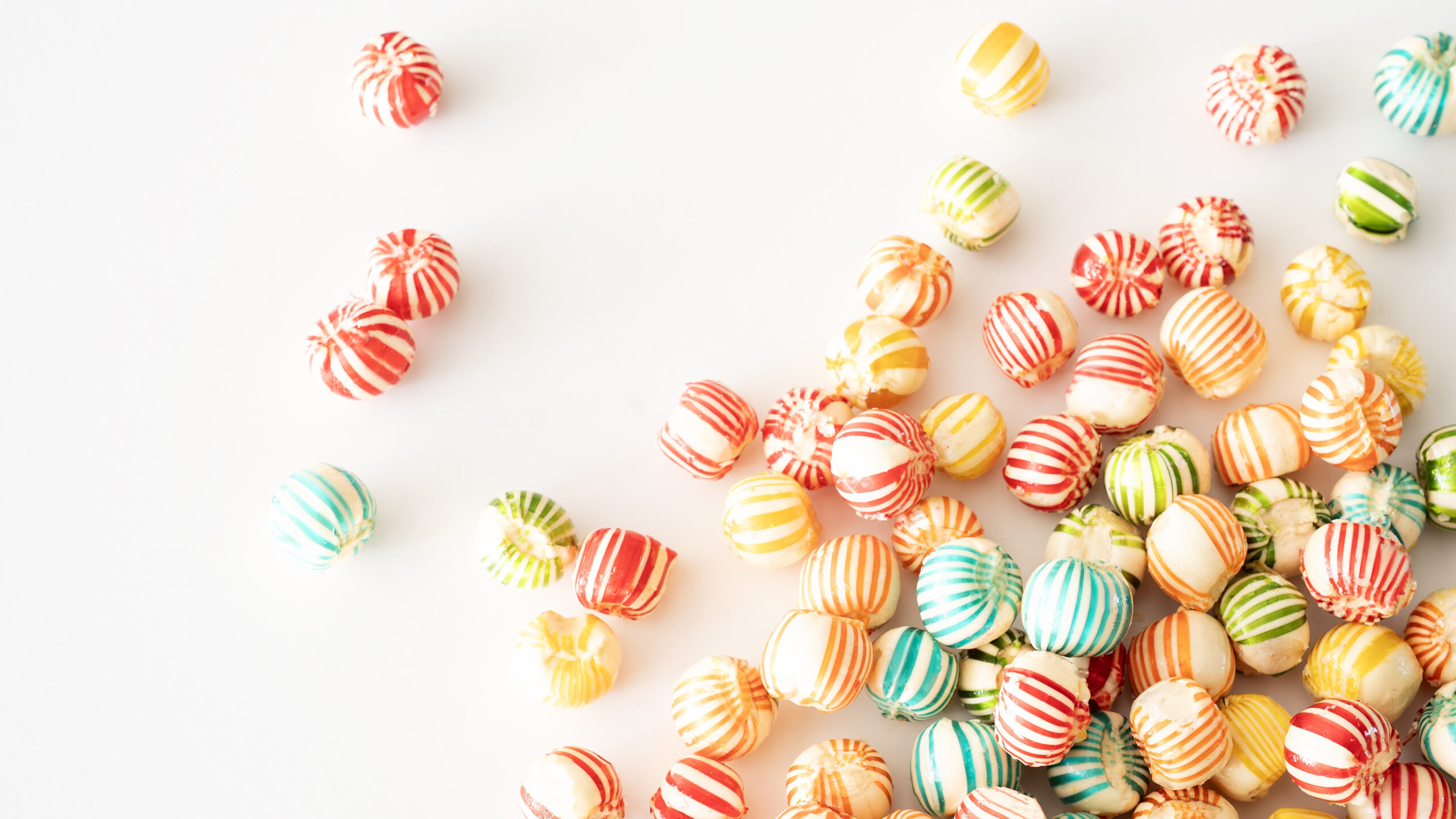
About fifty years ago, an article appeared in the magazine “Confectionery Production” with a title that was undoubtedly very significant and which can form the basis of what we are going to address in the following notes: SWEETS = SIMPLE COMPOSITION = COMPLEX STRUCTURE. Yes, the composition of traditional (hard) sweets is simple: sugar, glucose syrup (starch or glucose) – organic acid (if any) and flavouring. In fact, if the complexity of an industry’s problems were to be assessed solely by the number and composition of ingredients, the sweet industry would probably rank last. On the other hand, we are dealing with a process that is far from simple and conceals more than one difficulty during and after the process.
Sugars
In addition to the presence of sucrose, it is necessary to evaluate the behaviour of the added glucose syrup and its influence on the structure of the sweets, bearing in mind that this addition decreases the solubility of the sucrose, while increasing the amount of sugars in solution. In brief, the main functions of glucose syrup can be summarised as follows:
- Crystallisation control
- Control of the degree of sweetness
- Giving the sweet its “body”
- Increased shelf life
- Providing “shine”
- Last but not least, cost reduction
The quality of the syrup is undoubtedly important, especially for reducing any colour development during the cooking process, which is related to the formation of hydroxymethylfurfural. Studies carried out as early as 1955 have shown that acid-conversion glucose syrups with a high DE are more likely to cause unwanted colouration. The components of the syrups that cause this defect are mainly nitrogenous substances, as well as traces of metal residues and the presence of SO 2, which catalyse the reactions of the nitrogenous substances. As is well known, commercial starch syrups can be divided into three broad categories:
- Low conversion: 28–38 DE
- Medium conversion: 38–50 DE
- High conversion: above 50 DE
Generally speaking, high-conversion syrups are unsuitable for the production of hard sweets.
The presence of glucose leads to an increase in viscosity, which, as is well known, is influenced by temperature and concentration, as well as by the hygroscopicity of the final product.
Organic acids
The most commonly used acids are: citric acid, tartaric acid, malic acid and lactic acid. Their use may carry a risk of sucrose inversion; therefore, the way in which the acid is distributed within the sweet is of the utmost importance. The addition of acid before the syrups are cooked must be avoided at all costs. The most commonly used food acid is citric acid, although ideally, the type of acid contained in the fruit and/or its actual quantity should be taken into account; for example, bananas contain no citric acid, or only very small amounts, and so it would make no sense to use it when making a sweet with this flavour. In general, however, sweets should be acidified in varying proportions depending on the fruit in question: around 10 g/kg for citrus fruits, and lower amounts for other fruits.
The structure of a sweet: similarities with glass
Even before 1970, the German company Storck-Werk carried out a detailed study in collaboration with a research institute specialising in the glass industry. In fact, hard sweets and glass both exist in that metastable intermediate state between the amorphous and crystalline states, that is, the ‘molten’ state. This state is rarely found in nature and occurs only following volcanic eruptions, when molten magma cools very rapidly. The same phenomenon occurs in the production of glass and hard sweets; thus, for example, glass ‘beads’ can be likened to hard sweets, and glass wool to ‘cotton candy’. The interplay between the two states – amorphous and crystalline – of matter – microheterogeneity – results in products of undoubted interest in both glass and confectionery. For example, Pyroflam in the glass industry and fondant in the confectionery industry.