There is a distinctly Italian approach to the consumption of alcoholic beverages – a style that is distinctive and recognisable compared to other countries, particularly in Europe. This is the finding of the first study on the subject, commissioned by Federvini and conducted by the Department of Communication and Social Research at La Sapienza University in Rome, which provides empirical evidence confirming a characteristic that has long been recognised as a defining feature of Italian culture.
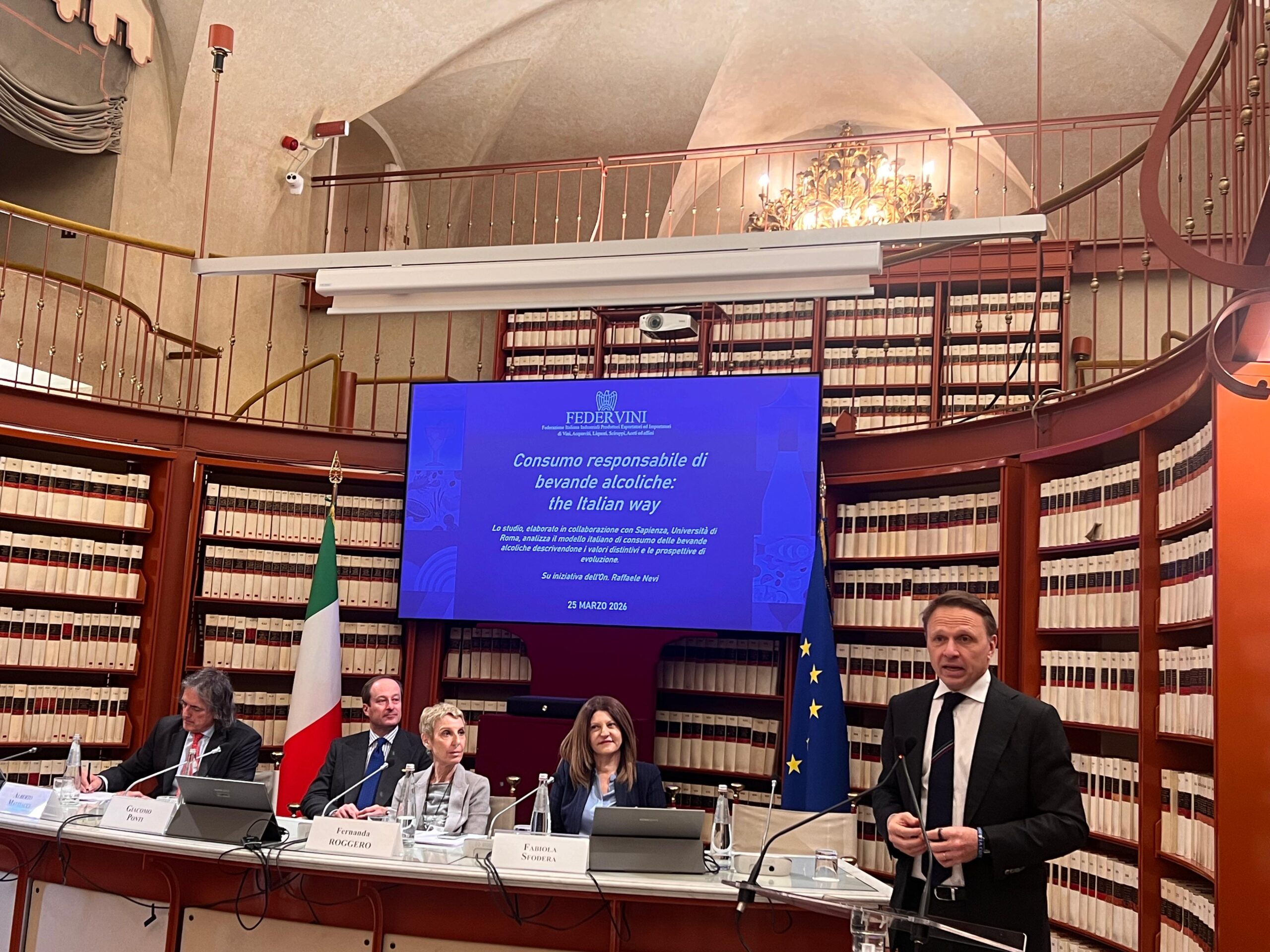
The study, presented today in Rome at the Chamber of Deputies during the ‘The Italian Way’ event, reveals that alcohol consumption in Italy is overwhelmingly moderate, ritualised and deeply rooted in social contexts and eating habits, largely in line with the principles of the Mediterranean diet. It is a model that integrates traditions, culture and social life.
Consumption appears to be structurally linked to mealtimes and social gatherings, with over 80% of wine consumption concentrated at lunch and dinner and over 70% of cocktails associated with aperitifs.
With an annual per capita alcohol consumption of 8 litres, Italy lies 6% below the OECD average and, within Europe, well below the levels seen in Central and Eastern European countries and the Iberian nations, where consumption ranges between 11 and 12 litres. In this context, a significant finding concerns the low incidence of risky behaviour, characterised by a gradual reduction in prevalence among the Italian population, which fell by 6 percentage points between 2007 and 2023.
These figures form part of a positive picture regarding health and life expectancy: according to Eurostat, Italy has the highest life expectancy in Europe at 84.1 years, a figure higher than the EU average of 81.5 years.
«Today we have further evidence of what we have always maintained:there is an Italian way of drinking, based on moderation, culture and responsibility. A model in which consumption is widespread yet mindful, ritualised and closely linked to meals and conviviality – comments Federvini President Giacomo Ponti -. It is precisely this style, based on tradition and culture, that proves more effective than the restrictive and prohibitionist policies that periodically resurface at international level. The Italian model has, over the centuries, fostered a network of businesses deeply rooted in their local areas, which contribute to the economy and represent a symbol of quality throughout the world».
Young people’s consumption
The survey conducted by La Sapienza University focuses specifically on young people aged between 18 and 24, whose drinking patterns show a gradual shift, with signs of a decline in both frequency and potentially risky behaviour. 72% have consumed at least one alcoholic drink in the last 12 months, with a higher prevalence among men (75%) than women (68%). The figure for daily consumption is significant: in this age group, it stands at 5.7%, compared with 31.3% among the over-75s, confirming a lower propensity for habitual consumption among younger generations.
Education and communication: Federvini’s commitment
In reaffirming the central role of education and awareness-raising as key tools for promoting a culture of responsible drinking, Federvini confirms its commitment, launched in 2022, to the “Communicating Responsible Consumption” programme in collaboration with the academic world.
The project has so far involved over 700 students from nine Italian universities: Sapienza University of Rome, University of Verona, University of Florence, University of Catania, University of Vicenza, Università Cattolica del Sacro Cuore in Milan, University of Campania Luigi Vanvitelli, LUISS Guido Carli and University of Turin.
Through this direct involvement, future communication professionals become the first ambassadors of an informed message to their peers. The project has involved two significant public-private partnerships, notably with the municipalities of Rome and Naples, which hosted two poster campaigns in their respective areas.