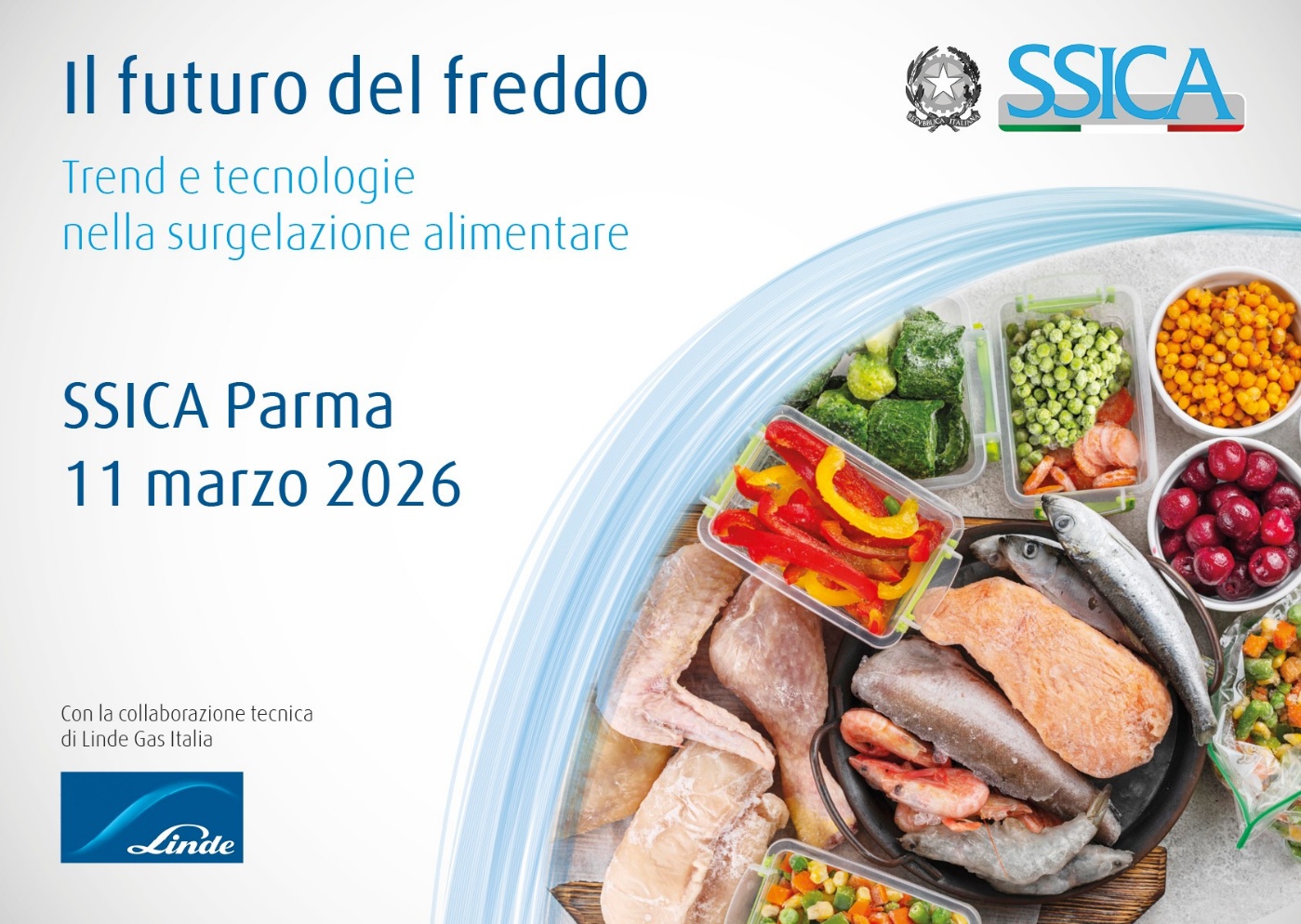
On 11 March, the seminar “The Future of Cold – Trends and Technologies in Food Freezing” was held in Parma, promoted by the Stazione Sperimentale per l’Industria delle Conserve Alimentari (SSICA) – Fondazione di Ricerca, with technical collaboration from Linde Gas Italia, a global player in the industrial gases sector.
“The 2025 data for the retail channel – stated Giorgio Donegani, President of the Istituto Italiano Alimenti Surgelati (IIAS) – confirm stable, structural growth in the frozen food sector: over 642,000 tonnes were consumed in Italian households, an increase of 1.1% compared to 2024. And these are only partial figures, as the data on out-of-home consumption will be available in July. However, the most significant aspect is not the figure itself, but what it reveals: more than one in two Italians regularly serve frozen products at mealtimes. Not out of emergency convenience, but as a conscious choice. Indeed, an AstraRicerche survey conducted for IIAS has shown that, in 4 out of5 cases, frozen food is more cost-effective than its fresh counterpart, without compromising on quality. In short, Italians have realised that frozen food is not an inferior alternative, but a smart response to the real needs of everyday life”.
One of the best practices for ensuring the organoleptic quality of frozen foods is IQF (Individual Quick Freezing), which was demonstrated during the seminar at the SSICA Pilot Plant Laboratory using Linde Gas Italia’sCryoline CW system.
“IQF freezing – explained Fabio Rolla, Cryogenic Freezing Expert at Linde Gas Italia – uses liquid nitrogen at −196°C and represents a pivotal development in the food industry, as it enables individual pieces to be frozen separately, preventing the formation of single blocks. This technology provides an optimal response to the demand for products that are easy to portion and quick to defrost”.