According to Global Growth Insights, the global non-alcoholic wine market reached $1.8 billion in 2025 and is expected to rise to $14.86 billion by 2035.
A key challenge for producers of zero-alcohol wine is preserving the product’s delicate flavour profile and several different dealcoholisation methods are employed to achieve this.
Vacuum distillation is a common method and is designed to retain the wine’s aroma. In this process, the wine is gently heated under a vacuum. The vacuum lowers the boiling point of alcohol, allowing it to evaporate at lower temperatures (typically 15 °C to 20 °C lower). This is followed by condensation.
Another technique is reverse osmosis. Wine is pushed through a semipermeable membrane under pressure, which separates the alcohol molecules from other wine components, such as pigments and tannins. In this way, larger molecules are separated from the alcohol.
In addition, many zero-alcohol wine producers use the spinning cone column to preserve the wine’s aroma. In this technique, wine flows over the columns, creating a thin film: as steam moves over the surface of the film and combines with airborne liquid droplets, volatile chemicals are stripped into the vapor. The stripped liquid is recovered, while the vapor flowing out the top of the column is sent, re-condensed, and recovered as a concentrated liquid form. The rotating cones increase surface area and lower the alcohol’s boiling point further, minimizing the product’s exposure to heat.
Following all of these processes, the dealcoholized wine is then put through a filtration process to ensure microbial stability, product quality and desired shelf life.
Risks of contamination and deterioration
However, due to the lack of alcohol content in these wines, producers can’t simply rely on the same filtration solutions they may have used to process alcoholic wines.
That’s because low or zero-alcohol products are more vulnerable to contamination and spoilage than their standard alcoholic counterparts. In zero-alcohol wines, there is an increased risk that certain microorganisms which can be harmful to human health, be detrimental to the taste profile and reduce shelf-life, can survive. These include yeasts such as Brettanomyces bruxellensis and Saccharomyces cerevisiae, and bacteria such as Lactobacillus brevis, Acetobacter oeni, Pseudomonas aeruginosa and Serratia marcescens.
Where does the risk stem from?
Alcohol is a natural inhibitor of microbial organisms, so removing it therefore creates greater contamination risk. There is also a higher residual sugar risk in zero-alcohol wine and with some products, sugar is added following the dealcoholization process to improve a product’s taste. The presence of this sugar creates a nutrient-rich environment for microorganisms.
There are further risks. The pH of zero-alcohol wines can differ to that of wines containing alcohol: this can allow other bacteria, that would not be a concern due to the acidic nature of standard alcoholic beers, to grow in a product.
Non-alcoholic wines are also more sensitive to oxygen which can lead to oxidation and the growth of aerobic microorganisms that can spoil the flavour and reduce shelf life.
Microorganisms can also adhere to the surfaces of packaging materials and equipment. If this isn’t controlled, biofilms can form and contaminate the wine during packaging.
Optimising filtration for zero-alcohol wine
In order to effectively remove microorganisms which can be present in zero-alcohol wines, filtration systems may require tighter membranes than those used in the microbial stabilisation of ‘traditional’ wines. And if a winery is introducing a zero-alcohol wine to its range, the filtration processes should be optimised for the new product.
Technical support from an established filtration specialist such as Parker can help wineries in overcoming the challenges posed by the increased risk of contamination in non-alcoholic wines. For example, in a recent case, a European producer of non-alcoholic wine had identified that Zygosaccharomyces was present in a its product, post-filtration. This genus of yeast can thrive in harsh, high-sugar environments and if it remains at the bottling stage it can re-ferment, causing sediment, an undesirable appearance and potential damage to the bottle. The company was using 0.45 micron membranes in the filtration process. However, following guidance from Parker, these were replaced by 0.2 micron membrane filters. Following this, no contamination was reported, indicating that the tighter membrane was successful in eliminating the presence of Zygosaccharomyces.
The importance of filter integrity testing
In preventing contamination of a zero-alcohol wine product, and process equipment, it is also vital that wineries and bottling plants identify incidences of filter failure by implementing regular filter integrity testing. This should be integrated into a Hazard Analysis and Critical Control Points (HACCP) system.
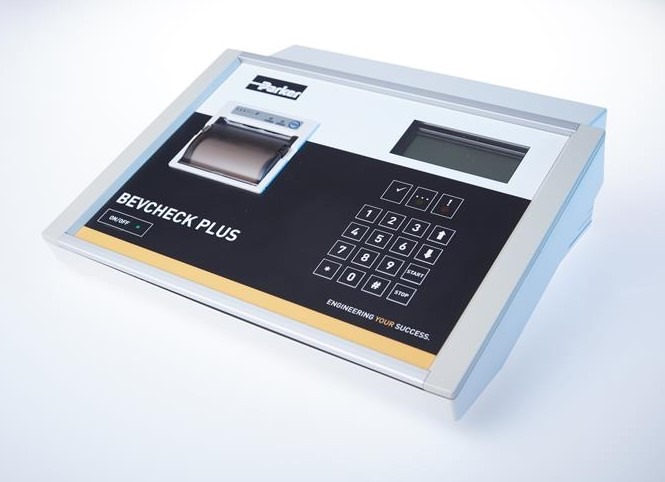
use compressed gas to accurately measure
the diffusion rate or pressure drop
of liquid membrane filters and to
provide operators with straightforward
‘pass/fail’ results
To support wine producers, Parker has developed BEVCHECK portable semi-automated integrity testing units and BEVCHECK PLUS fully automated integrity testing units. These solutions use compressed gas to accurately measure the diffusional flow or pressure decay of liquid membrane filters and provide operators with simple ‘pass or fail’ results.
The BEVCHECK and BEVCHECK PLUS units have IP53 splash proof protection and a robust construction and have been designed for use in wineries.
Other filtration and separation technologies by Parker
Parker offers several other filtration and separation technologies that bring significant benefits to your products and processes. Nitrogen is extensively used in winemaking to prevent oxidation, maintain flavour, and extend shelf life by displacing oxygen from tanks, barrels, and bottles. NITROSource nitrogen gas generators can cost effectively produce food grade nitrogen on demand using a source of compressed air for use in all your processes. Why buy nitrogen when you can make it! Parker also offers a full range of compressed air treatment filters and dryers that carry 3rd party certification for use within the food & beverage industry.
In defence of quality
To protect the quality of their products, brand reputation and operational efficiency, wineries introducing zero-alcohol wines to their ranges should put their processes under a microscope. Clearly it is essential that costly contamination incidents are prevented and production is maintained. But this is brought into even sharper focus by the substantial cost of dealcoholization equipment and its associated infrastructure. Wasted product batches will not help wineries receive a return on investment.
Drawing on a wealth of expertise, Parker’s Technical Support Group (TSG) can support businesses in optimizing their filtration processes and preventing contamination, including advising on filter selection, system design and cleaning processes, and providing on-site technical analysis
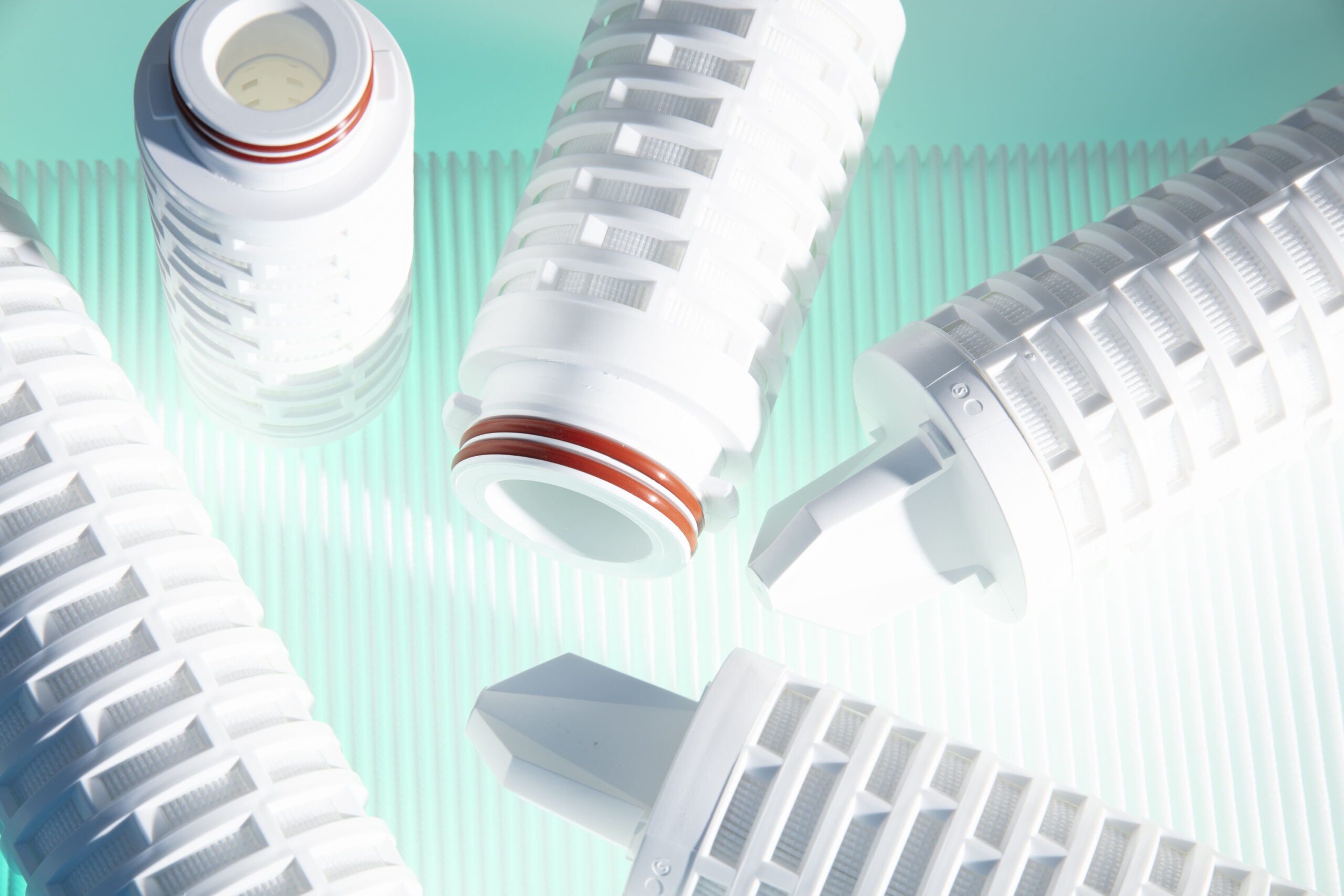
Parker has also developed a range of membrane filters for use in the wine industry, including the BEVPOR PS, BEVPOR PW and BEVPOR PH filters, which have been validated against typical wine spoilage organisms. It also recently launched BEVPOR Caustic Stable, developed for use by beverage manufacturers who need to employ higher concentrations (typically more than 2%) of Sodium Hydroxide in their Clean in Place (CIP) regimes.