Sixty-one percent of Italians say they feel unprepared to address a long-term, structural food crisis. This is one of the key findings from the research1 “Food Security in Europe: Italian Consumer Perceptions,” conducted by Excellera Intelligence and presented by Tetra Pak on April 17 at its headquarters in Modena (Italy).
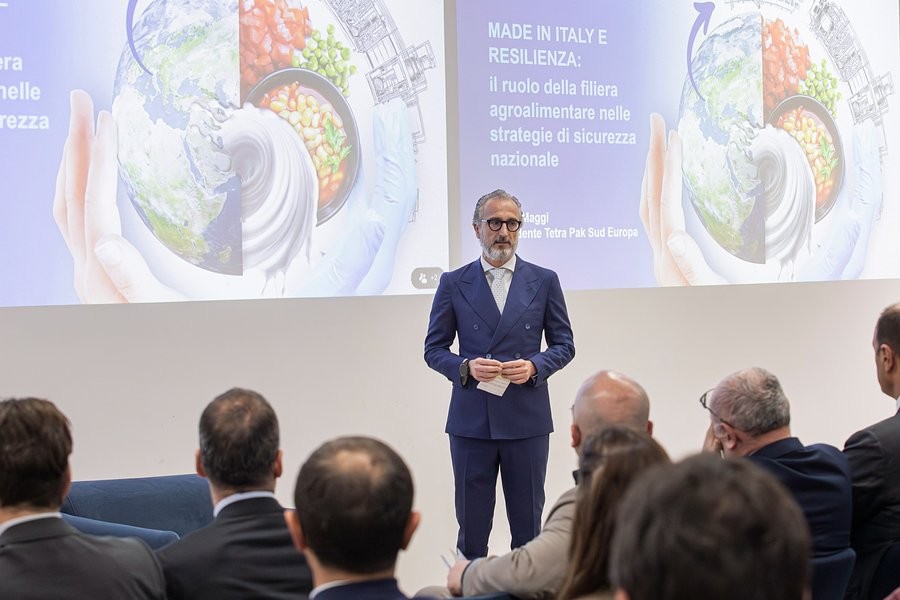
The presentation took place as part of the discussion “Made in Italy and Resilience. The Role of the Agri-Food Supply Chain in National Security Strategies,” part of the celebrations for National Made in Italy Day and at a time of renewed institutional attention on the topic, especially in light of the ongoing crisis in the Middle East.
Opening the meeting, Paolo Maggi, President and Managing Director of Tetra Pak South Europe, emphasized how food safety and food security are increasingly intertwined: “Today, food safety and food security are inseparable: ensuring food safety means ensuring hygiene and quality, but also access and availability, especially when the system is under stress. Many food crises arise not from a lack of food, but from disruptions to the infrastructure that enables its preservation and distribution. At Tetra Pak, we wanted to promote this discussion precisely to bring together institutions, industry, and the supply chain and contribute to concrete, implementable solutions. Food safety is a permanent and shared objective, requiring cooperation and a long-term vision“.
Regarding institutional interventions, Giacomo Vigna, Director of the Agro-industry Division of the Ministry of Business and Made in Italy (MIMIT), reiterated: “MIMIT confirms its commitment to supporting industrial policies based on assessment tools such as the ‘Food Security Test,’ which are essential for enhancing and strengthening Italian manufacturing leadership“.
The survey, presented by Aldo Cristadoro, CEO of Excellera Intelligence, captures a widespread awareness of the system’s vulnerability: 65% of Italians believe the food safety supply chain is exposed to risks that could compromise its functioning, a share higher than the European average (62%). Among the most significant risks perceived were food contamination and spoilage (67%), animal diseases (62%), and extreme weather events (42%), followed by the lack of adequate packaging systems (39%).
The increasingly close connection between food safety and geopolitical context was highlighted by Antonella Rossetti, member of the Cabinet of the European Commissioner for Agriculture and Food: “As Commissioner Christophe Hansen pointed out at the Munich Security Conference, ‘if we discuss security without including food, we are only covering half the battlefield.’ Today, we need to move from a mindset of reaction to one of preparation“.
Alongside these concerns, a cautious confidence emerges: 58% of Italians believe the system can withstand serious crises or extreme events, albeit with localized difficulties. In the event of supply disruptions, the main concerns include rising prices (71%), scarcity of certain products (41%), and reduced access to food for the most vulnerable (32%). In this scenario, packaged foods are perceived as the safest option.
Sara Roversi, Founder & President of the Future Food Institute, commented on the role of packaging as a strategic infrastructure: “Food safety depends on the ability to connect production, processing, and access. In this space, companies like Tetra Pak are invisible but essential infrastructures, because they enable access to food even in the most fragile contexts“.
Regarding European packaging policies, Italian consumers are demanding that legislators prioritize contamination prevention (51%), shelf life (43%), and food affordability (31%). Not surprisingly, 76% believe that without adequate packaging solutions, the ability to address a food crisis would be reduced, while over 80% underline the importance of European supply chains and supplies to reduce the risk of disruption.
During the roundtable discussion “Food Security as a Key to National Defense“, organized during the Tetra Pak event, Michele Barcaiuolo, Senator of the Republic and member of the Foreign Affairs and Defense Committee, stated: “With the bill on food security and continuity, we are proposing concrete tools: a national plan, a control room, and strategic stockpile systems. Food security must become a guiding criterion for European decisions, introducing tools such as a true Food Security Test“.
Luigi Scordamaglia, CEO of Filiera Italia, added: “We have called for the activation of strategic agri-food stocks to make the country less exposed to global shocks and supply chain disruptions, and we have therefore proposed allocating adequate resources in the Competitiveness Fund for European storage infrastructures that currently do not exist. We welcome the establishment of a National Plan, to be included in a Community framework“.
Maurizio Gardini, President of Conserve Italia, commented: “Sustainability is central, but it must be pursued without compromising production capacity. We need European policies that combine transition, competitiveness, and food security“.
Andrea Taglini, Councilor of UCIMA, highlighted the role of packaging: “The study shows that food security is perceived as a fragile system. In this context, packaging is not a detail, but a lever for national security“.
Closing the event was Davide Baruffi, Councilor for Budget of the Emilia-Romagna Region: “Safety and sustainability are essential objectives. To achieve them, agriculture and industry must work together, integrating business, research, and expertise“.
- The research was conducted by Excellera Intelligence in Italy, Germany, France, and Spain, with 800 interviews in each country among a population aged 18-74. The surveys were conducted using the CAWI methodology, using a structured questionnaire lasting approximately 12 minutes, on a random sample stratified by gender, age, educational level, occupation, and area of residence. Execution period: late February-March 2026. ↩︎