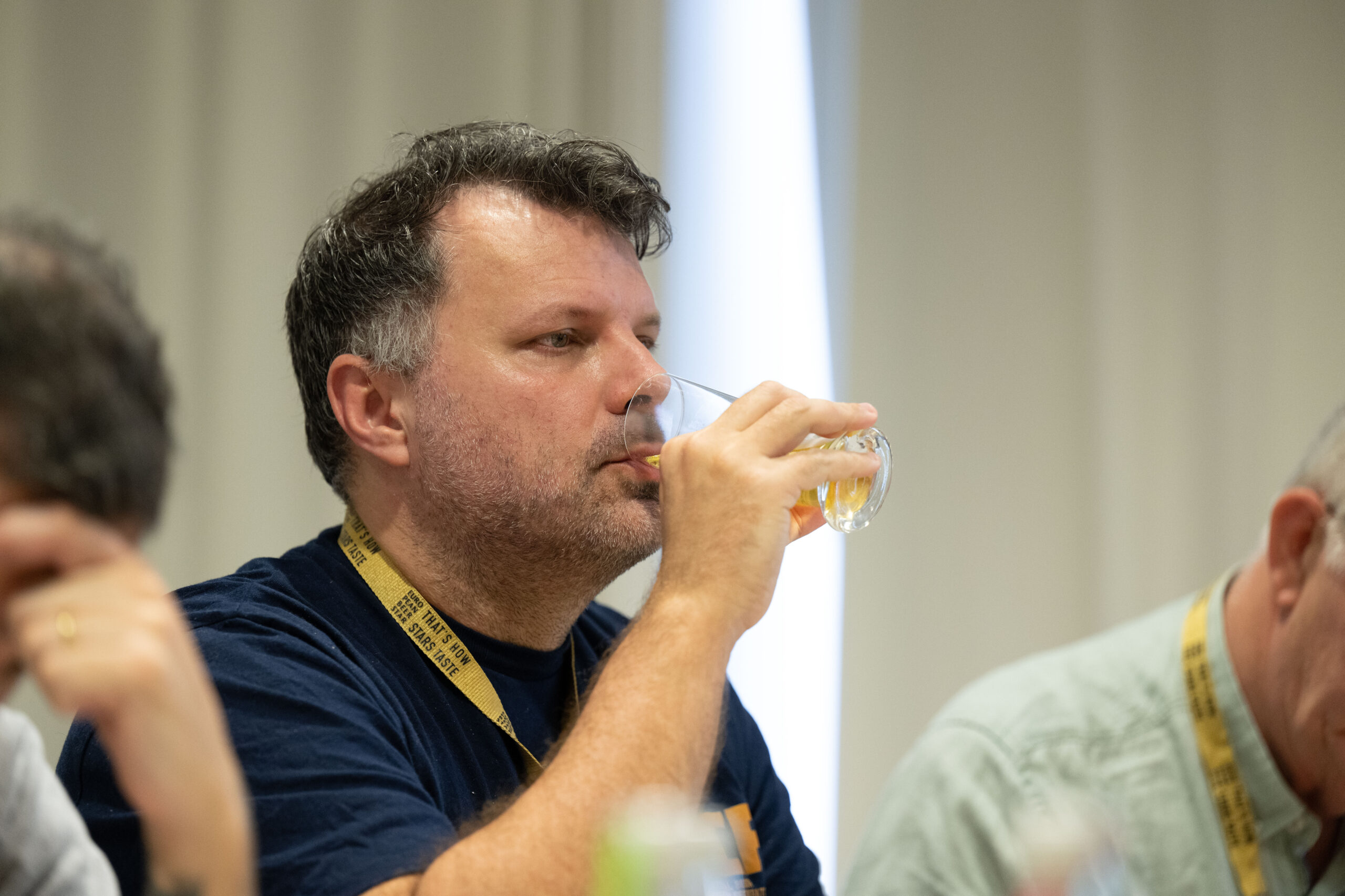
Douglas Merlo began his journey in the world of craft beer in Italy, where he lived from 2004 to 2012. It was there that he attended his first “Beer Taster” course and met several of Italy’s most important master brewers. For more than 15 years, he has represented Brazil in some of the world’s most prestigious beer competitions (Belgium, South Korea, the United States, Italy, Chile, Argentina, Uruguay, Germany, and the Netherlands). A former professor in the Doemens Biersommelier course in Brazil, he is also the founder and guide of Expedição Cervejeira®.
In 2018, he was named a “Knight of Belgian Beer,” one of the highest honors in the world awarded by the Belgian Brewers Association to individuals who promote and spread beer culture in their own country and internationally. In 2020, he became the first Brazilian admitted as a member of the British Guild of Beer Writers, founded in England in 1988 to promote beer, breweries, and pub culture, and regarded as one of the world’s leading sources of information on brewing culture.
In 2021, he became the first Brazilian to reach the finals of the Guild’s annual award in England in the category “Best Citizen Beer Communicator,” thanks to a project launched on his YouTube channel that competed against more than 150 projects from around the world.
Douglas is also one of the most awarded homebrewers in Brazil, with more than 80 medals in national and international competitions. In 2022, he was inducted into the “Brazilian Beer Hall of Fame,” an annual tribute held during Brazilian Beer Week, recognizing five individuals who have made a significant contribution to the Brazilian beer movement. He is an ambassador for Belgian Beer Week in Brazil and Latin America. In 2025, he became the Brazilian ambassador for the Brussels Beer Challenge. He is the Technical Director of CBC BRASIL (Concurso Brasileiro de Cervejas), the world’s largest independent beer competition, with more than 4,000 beers entered, as well as director of the BBA – Brazilian International Beer Awards, the world’s third largest international beer competition in terms of participating countries.
Douglas, what is the current state of the craft beer production landscape in Brazil?
«After more than 10 years of continuous growth in both production and consumption, Brazilian craft beer is now experiencing a major slowdown, confirmed by the closure or sale of dozens of breweries. Among the causes are factors such as the weakening of the Brazilian currency, rising production costs, and the arrival on the market of mass-produced ‘hype’ beers from the industrial sector».
What similarities are there, if any, with the international craft beer movement?
«The close connection with the U.S. market means that the Brazilian beer scene often looks to that reality for inspiration. In fact, new styles and trends that emerge there are replicated here within just a few weeks. Then there are some Brazilian cities founded by Germans, such as Blumenau or Pomerode, where German culture – including beer culture – is still very tangible».
If you could bring something from the Italian craft beer movement to Brazil, what would it be?
«It’s difficult because Brazil is a very large and very hot country. For this reason, if a brewery wants to make its bottled beers available throughout an entire state, it cannot afford not to stabilize the product through pasteurization. Maintaining a full cold chain is certainly possible, but it would significantly increase product costs. Some breweries in the ‘colder’ regions are trying to move in this direction with bottle-conditioned, unpasteurized beers. In any case, the distribution radius in these situations rarely exceeds 50 km from the brewery».
And what from the Brazilian experience would you bring to Italy?
«For some time now, Brazilian breweries have been exploring spices, fruits, and exotic Brazilian woods that represent an incredible biodiversity heritage in both quality and quantity. Italy is also rich in Mediterranean spices, berries, and ingredients that exist only in Italy — or that evoke Italy when used in brewing — such as basil, thyme, and of course grapes. The curiosity and drive to explore flavors unique to Brazil could serve as an example for Italian craft brewing».
Beer competitions: do you think there is something that should be reconsidered in the judging system, or is it fine as it is?
«As the technical director of two competitions (Concurso Brasileiro de Cervejas and the Brazil International Beer Awards), I believe they are extremely important for breweries, both from a marketing perspective and for the feedback brewers receive from knowledgeable and competent judges to improve their products. There are also competitions I personally dislike – those where merit seems to matter very little, where there are more awards than beers entered, just to be clear. In a way, these damage the reputation of the more serious competitions. In Europe, I would mention the European Beer Star and the Brussels Beer Challenge, while in Italy I would highlight Birra dell’Anno».
If I say Catharina Sour…
«Catharina Sour is a Brazilian style that was born somewhat by chance thanks to a kind of lobbying effort by Brazilian breweries toward the Beer Judge Certification Program (BJCP). At the time, both in Brazil and Europe, beers inspired by American sours were becoming popular: beers brewed with wheat, acidified with lactic bacteria, and enriched with fruit additions. The innovation lies in the use of tropical fruits, making it a regional expression similar to Italian Grape Ale. The style experienced a strong boom in consumption and remains popular, although today there is a slight decline, as is happening with all sour craft beers. The defining characteristic of Catharina Sour is the use of fruits that can only be found here. In Brazilian competitions, judges encounter a sensory experience filled with aromas of exotic Amazonian fruits they have never smelled before in their lives».
And if I said IGA…
«I experienced the rise of IGA while I was still living in Italy. I remain a great enthusiast of both sour and non-sour versions, barrel-aged or otherwise. I also began working on them in Brazil after being contacted by a local brewery in southern Brazil (Cervejaria Leopoldina), owned by a winery. Together, we developed the first IGA in Brazil, based on a Saison style with the addition of 30% Chardonnay grape must produced by the winery itself. The beer distinguished itself in several competitions. Starting from that first release, many others were developed, and one in particular was named the best Brazilian beer in the national competition among 4,000 entries. Today, that beer is considered a national benchmark, and last year at the European Beer Star it outperformed many Italian beers. Several Italian judges invited to competitions in Brazil had the opportunity to appreciate its production».
One of your activities is organizing beer tourism trips from Brazil to historic European brewing countries. Imagining the reverse journey, what would be the key destinations for a European craft beer lover?
«Expedição Cervejeira, which means ‘Beer Expedition’ in Italian, is the business I founded shortly after returning to Brazil, when I realized that most enthusiasts, brewers, and professionals in the industry had never experienced firsthand the reality of Europe’s brewing tradition countries. I thought my travels and the brewing relationships I had built in Europe could be put to good use in this sense. Today, my company is the number one beer tourism company in Latin America, which makes me particularly happy and proud. Organizing a beer trip in Brazil means first taking into account the vast size of the country, which would require much more than the ten or fifteen days usually dedicated to European tours. Just exploring the South, with its huge number of breweries, would take more than a month. Other states such as São Paulo, Espírito Santo, and Minas Gerais also offer activities of great interest, especially Minas Gerais for the remarkable interaction between beer, coffee, spices, fruits, and wood. For the European beer enthusiast, Brazil would be a true playground».
Beer communication needs…
«More transparency!».