Getting to know a place like Carrobiolo means immersing yourself in a wealth of expertise, dedication, and brewing culture. The craft of the artisan brewer? A refined blend of technique and mastery. And—above all—practical sense.
The first brewery in Monza
Considered a local institution, Birrificio del Carrobiolo combines production and a brewpub under one roof. There’s even a kitchen –serving delicious, well-crafted dishes – that rounds out the experience. Since 2014, a 30-meter underground beer pipeline has connected the pub’s ten taps to 1,000-liter refrigerated tanks. An invisible yet vital network, capable of quenching the thirst not only of locals but also of visitors from outside the province. There’s something for non-drinkers too, though not much, as Pietro notes with a touch of irony. To truly understand the soul of the brewery, one must look to its roots. From 2008 to 2018, it was known as Birra del Convento Carrobiolo. The idea to brew beer stemmed from an intuition by Fontana, who at the time was an educator at a day center for teenagers. The goal? To teach a trade – that of the brewer – as a tool for personal growth and raising awareness about responsible drinking. Batch after batch, the educational workshop evolved into a business capable of providing jobs and opportunities. In 2014, the brewery doubled its space and opened a second location in Piazza dell’Indipendenza in downtown Monza, within an old courtyard. The two facilities operated side by side until 2018, when the small-scale production that began inside the convent ceased, with all efforts focused on the new location.
Today, Birrificio del Carrobiolo is made up of a team of eighteen people working in production and serving beer at the taproom. It’s a deeply artisanal operation where craftsmanship and inspiration are the daily fuel. During the tour, I press Pietro, asking him what his philosophy is. He doesn’t answer. He smiles. I get the hint. And I tell myself, “One sip at a time, we’ll get there”.
Think globally, drink locally
The brewery’s mantra. Pietro is straightforward – in both word and deed. Just like his Keller (4.5% ABV), a true institution for Carrobiolo regulars and for those who love styles inspired by traditional Franconian beers. A crisp lager with extraordinary drinkability: “Bringing the mug to your nose is like taking a trip to the bakery”, he confesses. For him, the beauty of beer lies in freedom: the freedom to interpret styles, to experiment, to find one’s own voice without chasing dogmas or strict protocols. The craft world, he explains, is a more open creative terrain than wine. Every beer can become a statement of intent, a small personal milestone. Fontana and his partner Diego Mazzuchelli know the Italian brewing scene well, but they consciously choose to keep their feet on the ground. Distribution is concentrated in Lombardy, consistent with the short-chain vision that has always guided the brewery. In the 800-square-meter facility – with its distinctive horseshoe shape – the spaces are mirrored: a face-to-face arrangement between production and the brewpub. Two inseparable souls, each a natural extension of the other. The same principle drives their approach to beer. On one hand, traditional styles; on the other, the curiosity to push the boundaries with bolder creations: “Beers where brewers love to flex their muscles and intuition”, he says jokingly. Among the most original beers, ITA – Italian Tomato Ale (5% ABV) –stands out. It’s flavored with Italian cherry tomatoes, basil, and oregano instead of hops. A pale ale with an unmistakable aromatic profile, where the freshness of the tomato and aromatic herbs delivers a harmonious and lingering finish. It could be described as the liquid version of pizza. Simply irresistible! And for those who want to try their hand at it, Pietro is quick to share a technical tip: “Never use tomatoes with the skin on, otherwise it clogs up the whole system!” Among the brewery’s other creations: the Porcini Imperial Stout, flavored with porcini mushrooms, and the Moscato di Scanzo grape beer (Red Italian Grape Ale); produced once a year.
Behind the scenes: where it all comes together
hectoliters, but the brewhouse can handle up to
13 or 14, depending on the style. Typically, a
single brew yields between 1,000 and 1,200
liters of beer, which increases to 2,000 liters
in double brews
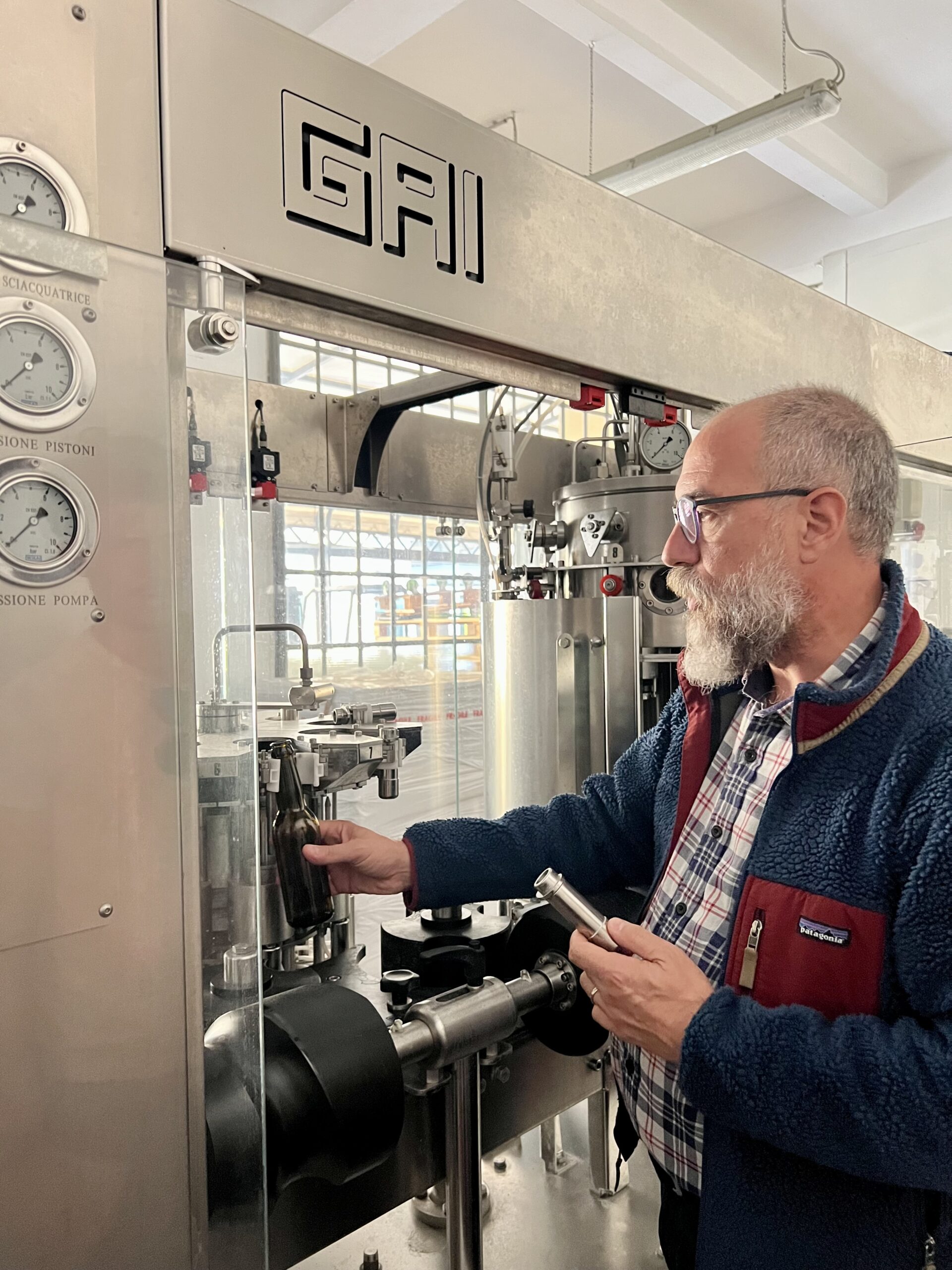
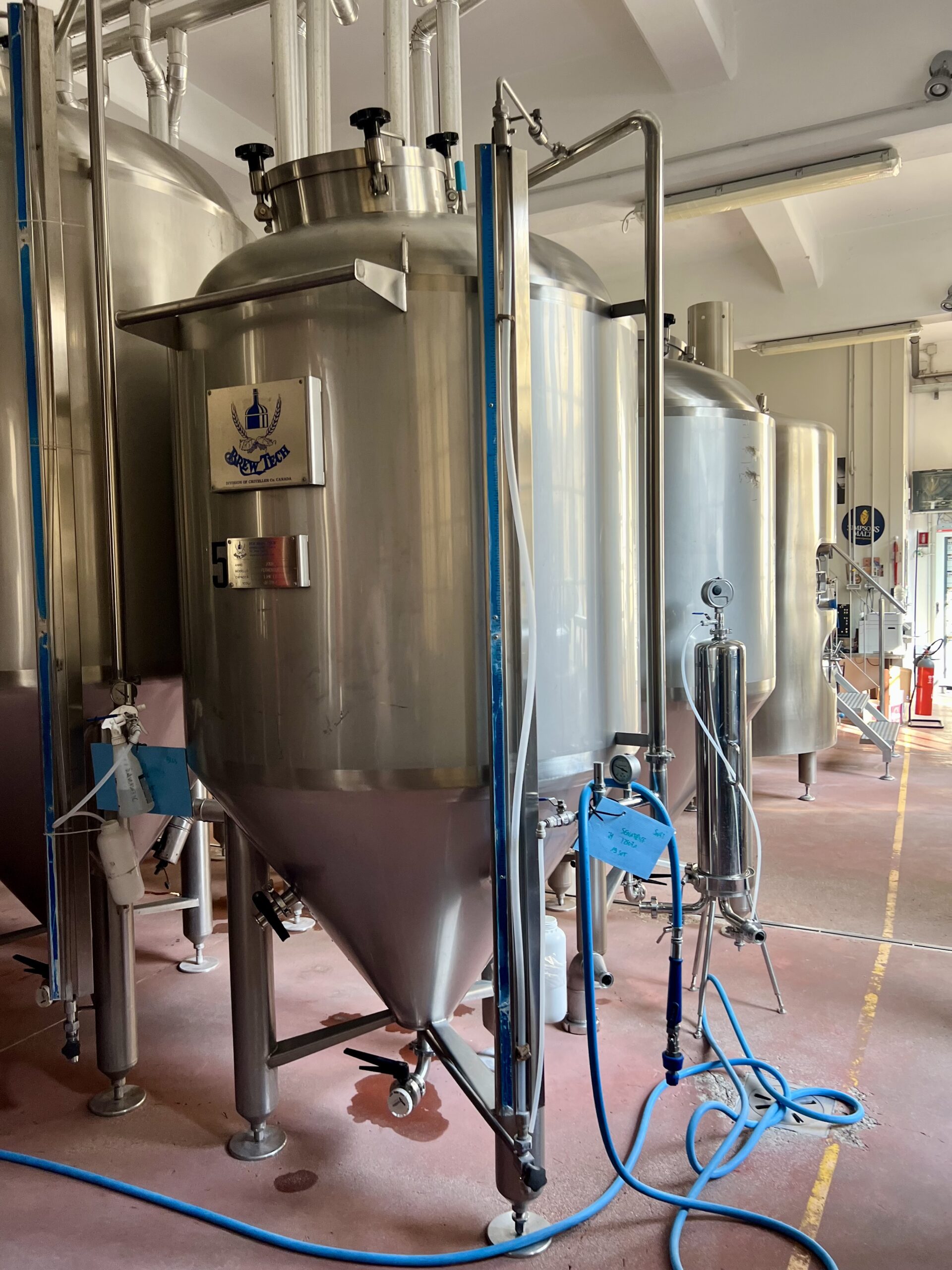
The production facility has a capacity of 12 hectoliters, but the brewhouse can handle up to 13 or 14, depending on the style. This is the case, for example, with light beers like Berliner Weisse, where water plays a key role and the alcohol content is around 3% ABV. Typically, a single brew yields between 1,000 and 1,200 liters of beer, which increases to 2,000 liters with double brews. Once the wort is obtained, it is transferred to the 25 fermenters: 13 vertical (8 holding 1,000 liters and 5 holding 2,000 liters) and 12 horizontal 10-hectoliter tanks, intended exclusively for the pub. In 2024, the brewery produced approximately 30,000 33-cl bottles, equivalent to 10,000 liters, out of a total annual production of about 100,000 liters. Of these, 40,000 were used for 24-liter stainless steel kegs; the rest is tapped directly at the brewpub. Down to the last drop. Maturation ranges from three to six weeks, depending on the type of beer. This is followed by secondary fermentation for glass bottles, while cans and kegs are packaged under pressure. The range of styles produced is wide: about twenty, ranging from classic and specialty beers to more experimental ones. Among the new offerings is a beer with added grapes during maturation in terracotta amphorae: a project that blends viticulture and brewing research. There’s no shortage of enthusiasm for experimenting with barrels again: the BarriC Project, which Pietro and his team plan to relaunch soon, is a shining example of this. When it comes to raw materials, the brewery primarily uses Slovenian and Czech malts from small producers, complemented by Italian malts selected for their distinctive character. These are often unmalted grains, such as spelt used in place of wheat in their Weisse (Dinkel Weisse, 4.6% ABV), an original interpretation of the Bavarian style. Another example is Cappelli durum wheat, the star of the Blanche. In the Saison (5.7% ABV), on the other hand, raw wheat from Cascina Rampina in Monticello Brianza – located just 20 km from the brewery – is used. This choice highlights the short supply chain and the connection with local producers. This is complemented by a Farmhouse ALE-style version, with the final addition of millions of Brettanomyces cells; this imparts rustic, tart nuances and a more complex aromatic profile. The beer is further enhanced by hops from a small Slovenian family farm and a traditional yeast strain recovered and propagated directly by the brewery. The hallmarks of a tailored approach are clearly evident. It is not surprising, however, that the Italian agricultural sector still struggles to meet the industry’s needs: in 2024, over 75% of the malt used in Italy was imported. This figure reflects the need to develop a more structured national agricultural supply chain, as also highlighted during the Beer Supply Chain Conference organized by our magazine in Milan, now in its seventh edition. Carrobiolo uses foreign hops, imported through the Modena-based Italian Hops Company; it selects high-quality varieties from the main producing countries. Bottling: the brewery is equipped with an eight-spout rotary monoblock bottling machine, a GAI 1531 FM Bier installed in 2014, capable of bottling up to 1,500 bottles per hour. For limited productions and special formats, a two-spout manual bottling machine is used instead.
The night before the exams
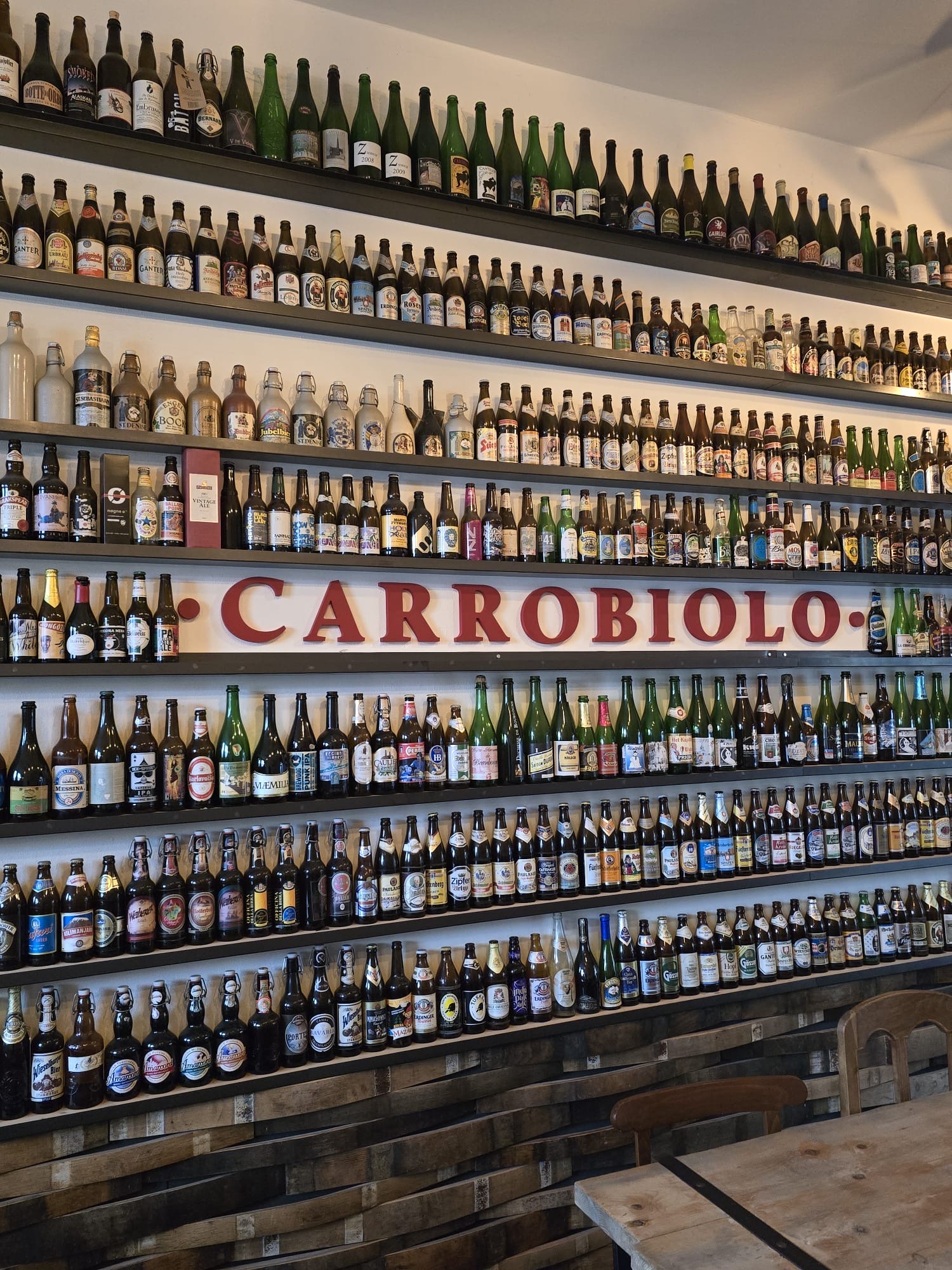
I say goodbye to Pietro, but before getting into the car, I turn back. “You still haven’t told me how your passion for beer began!” I ask him. His eyes light up. The memory comes flooding back, as if it were yesterday. “The day before my first high school final exam, a friend and I decided to have a drink to ease the tension. We ended up at a bar. Terrible. But with one surprising detail: it had a beer bottle menu! More than fifteen varieties. Back then, it was a rarity, if not an exception. We ordered one, then another… and from there, I never looked back!” That small gesture – choosing a beer from a list – already held the seed of a passion destined to blossom. Since then, Pietro hasn’t stopped. He began collecting bottles on which he noted the date, taste impressions, and anecdotes. A sort of diary. “All those bottles are a fragment of me. They taught me to taste. To travel through the atlas. Beer isn’t just a drink, but a language: the art of expressing oneself through a liquid.” As I listen to him, spellbound, I realize that the brewery’s philosophy stems precisely from here: from the way Pietro views the world. With curiosity. With respect. With that thirst for knowledge that transforms every gesture, even the simplest, into an act of wonder. In the end, he has already answered the question he initially refused to address. If you ever find yourself at Carrobiolo, in one of the brewpub’s rooms, you’ll be able to capture these moments in time. And to think that, in the past, the courtyard where the brewery stands today was home to a hat factory. It really is fitting to say: chapeau!