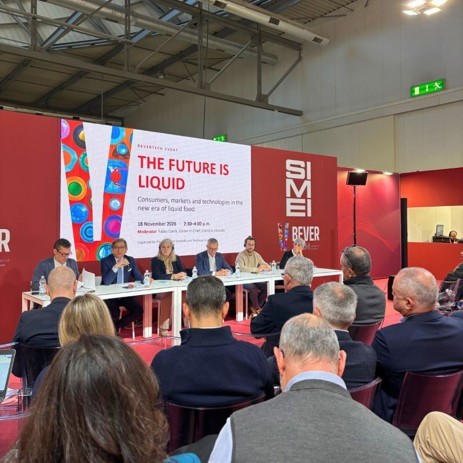
An increasingly liquid market, because consumers are too. From fruit (and vegetable) juices to functional beverages, from cider to alcohol-free wine, the beverage sector is offering an increasing number of consumption occasions, and it is these that are driving an increasingly segmented demand. This was the picture that emerged yesterday at Bevertech during the conference “The future is liquid: consumers, markets and technologies in the new era of liquid food”, moderated by the editor of Il Corriere Vinicolo, Fabio Ciarla, who compared trends and growth prospects in the various sectors.
With fruit and vegetable juices growing at a compound annual growth rate (CAGR) of 8.5% in value over the last five years, functional beverages set to double in the next seven years (from $165 billion to $316 billion), and even the niche of alcohol-free wines with a CAGR of around +11% over the next five years, a scenario is emerging in which turnover growth often outstrips quantitative growth, and the ability to identify new needs is becoming crucial for companies’ competitiveness. The word “functionality” is the common denominator in the paradigm shift in consumer habits.
“Quenching thirst is no longer enough,” explained Cinzia Menchise, Director of the “Supplements and Health” and “Specialised Nutrition” divisions at Unione Italiana Food . And while it’s true that taste remains key, today’s consumer standing in front of the shelf asks themselves: what can this drink give me? It is functionality that is increasingly guiding choices.” “People are looking for drinks that meet specific needs, as we can also see from the shift towards increasingly on-the-go formats,” said Aintzane Esturo, Technical Director of the International Fruit and Vegetable Juice Association (IFU). “Fruit juices, too, are moving away from breakfast to establish new habits and rituals, embracing health trends and placing ever greater emphasis on sustainability.” One example above all – presented by the Vice President of the World Processing Tomato Council (WPTC), Antonio Casana – is Japan, where tomato juice has been promoted as a functional beverage through products associated with GABA (gamma-aminobutyric acid, with relaxing properties), with consumption and turnover in the segment doubling over a six-year period.
According to Carlo Flamini, Head of the Wine Observatory of the Italian Wine Union (UIV): “Even in the case of wine, we need to stop talking about the product and make it clear what our product is for. If we don’t work on this awareness, it becomes impossible to identify the contexts and opportunities that enable us to broaden our consumer base. And this applies to low-alcohol wines but especially to traditional wine.”
“If, over the past thirty years, it has been the product that has adapted to technology, today it is technology that has to keep pace with the evolution of demand,” said Luciano Sottile, Chair of the Technical and Scientific Committee of Ipack Ima. According to Aymeric Lemarchand, a consultant specialising in cider and apple-based drinks and founder of Poum!, this approach requires greater creativity and a willingness to overcome certain cultural and regulatory constraints. An openness to change, in the words of Ce.Vi.V’s Chief Investment Officer, Gianni Tadiotto. But that’s not all. AsGiovanni Mazzon (Engineering and R&D Manager at Omnia Technologies) explains, this transformation also brings new industrial challenges, from product stability to shelf life, as well as in packaging and in terms of sustainability.