In recent years, companies operating in the bottling and packaging sector have faced a dual challenge: maintaining high plant availability while simultaneously evolving toward increasingly digital and data-driven management.
In this scenario, Consertech – based in Presezzo, Italy – acts as a system integrator. Its distinctive value lies in the ability to bridge different realities, technologies, and suppliers, building a unique, coherent, and perfectly integrated system for the client.
Consertech does not merely provide individual solutions; it designs, manages, and coordinates complete projects. By selecting technological partners and integrating heterogeneous machinery and software, it creates an infrastructure where all components operate synergistically. This approach overcomes the fragmentation typical of complex plants, where technologies from different manufacturers often fail to communicate.
Core services and methodological approach
«Our organization offers audit, revamping, and packaging line optimization services, with a specific focus on availability, performance, and safety – explains Nicolò Vallazza, CEO of Consertech -. We adopt a multidisciplinary approach: we begin by analyzing the entire chain to identify bottlenecks and mechanical or electrical criticalities, while prioritizing opportunities for improvement, including the development of tailored layouts».
The protagonist of the case study presented here is a beverage industry client specializing in glass and PET packaging, which over time had developed a complex and poorly integrated machine fleet. The challenge was not only technical but primarily managerial: the lack of a unified vision made it difficult to monitor performance and make informed, rapid decisions.
Through Consertech’s intervention, it was possible to implement an integrated system called NEXA (developed by Consertech), where machines, data, and processes communicate regardless of their origin or the management software used. Efficiency and sustainability in beverage bottling require highly reliable, flexible, and integrated MES systems. Traceability, energy management, and performance control demand modern requirements, such as interoperability and the ability to adapt to Industry 4.0 and 5.0.on interoperabilità, capacità di adattamento all’Industria 4.0 e 5.0, e caratteristiche tecniche e funzionali mirate.
«Full traceability of work orders and batches in bottling lines is essential for quality, safety, and regulatory compliance. An MES system records all information regarding materials used, machinery involved, and process parameters in real-time, preventing transcription errors and ensuring accurate control at every stage – adds Daniele Pintus, Head of R&D at Consertech -. The result was the integration of a 4.0 system, named NEXA, designed to transform raw information into indicators that are useful and immediately interpretable by operators, department managers, and executive leadership».
NEXA: Industry 4.0 data collection
NEXA is a software platform designed for the collection and management of machine states, events, and operating parameters. The system interfaces with existing PLC, SCADA, and HMI units, acquiring data on cycles, downtimes, rejections, alarms, and energy consumption without the need to replace existing automation.
The configuration is modular: each machine or station is mapped as a distinct entity with coded states (e.g., running, stopped, maintenance, setup), allowing for the reconstruction of operational history and the analysis of unavailability causes. Dashboards, accessible via web or local terminals, display key KPIs such as OEE, availability, performance, and quality, with filters by shift, product, and machine.

Case study: packaging line revamping
- Line type: Packaging and control.
- Main pre-revamping issues: Lack of bottle compliance control and rejection management. Regarding transport, there was a need for automated rail positioning using a specific recipe shared via M2M (Machine-to-Machine) communication.
- Data management: Modifications to the operator panel for incoming data visualization and creation of databases (DB) for outgoing data, interconnected with MES-ERP systems in an Industry 4.0/5.0 logic.
- Client objective: Ability to relate incoming and outgoing data with work orders, batches, and shifts to obtain statistical history. Using the resulting KPIs, the client aimed to identify the best work method to correct inefficiencies and improve the production cycle.
Technical analysis and solution
Nicolò Verza, Senior Line & Plant Engineer & OEM Specialist, describes the project approach as follows: «In the initial phase, an in-depth analysis was carried out, based on direct observations, operator interviews, and analysis of historical OEE data. The line was divided into critical sections – loading, filling, capping, labeling, and secondary packaging – and, for each of these, the main contributors to time losses were identified».
NEXA implementation and integration
The implementation took place in several phases. After the design, construction, and wiring of the electrical panel, the automation and safety setup of the line were carried out. This was followed by mechanical testing, and the new sensors and updated logic were put into operation and verified.
Subsequently, NEXA was connected to the automation network and properly parameterized to acquire the defined states and events. During commissioning, operators and technical staff received short training sessions to understand the meaning of machine states and how to use the dashboards.
The first weeks were dedicated to data validation and parameter calibration, ensuring that downtime and rejection counts were as closely aligned as possible with actual operating conditions.
Results
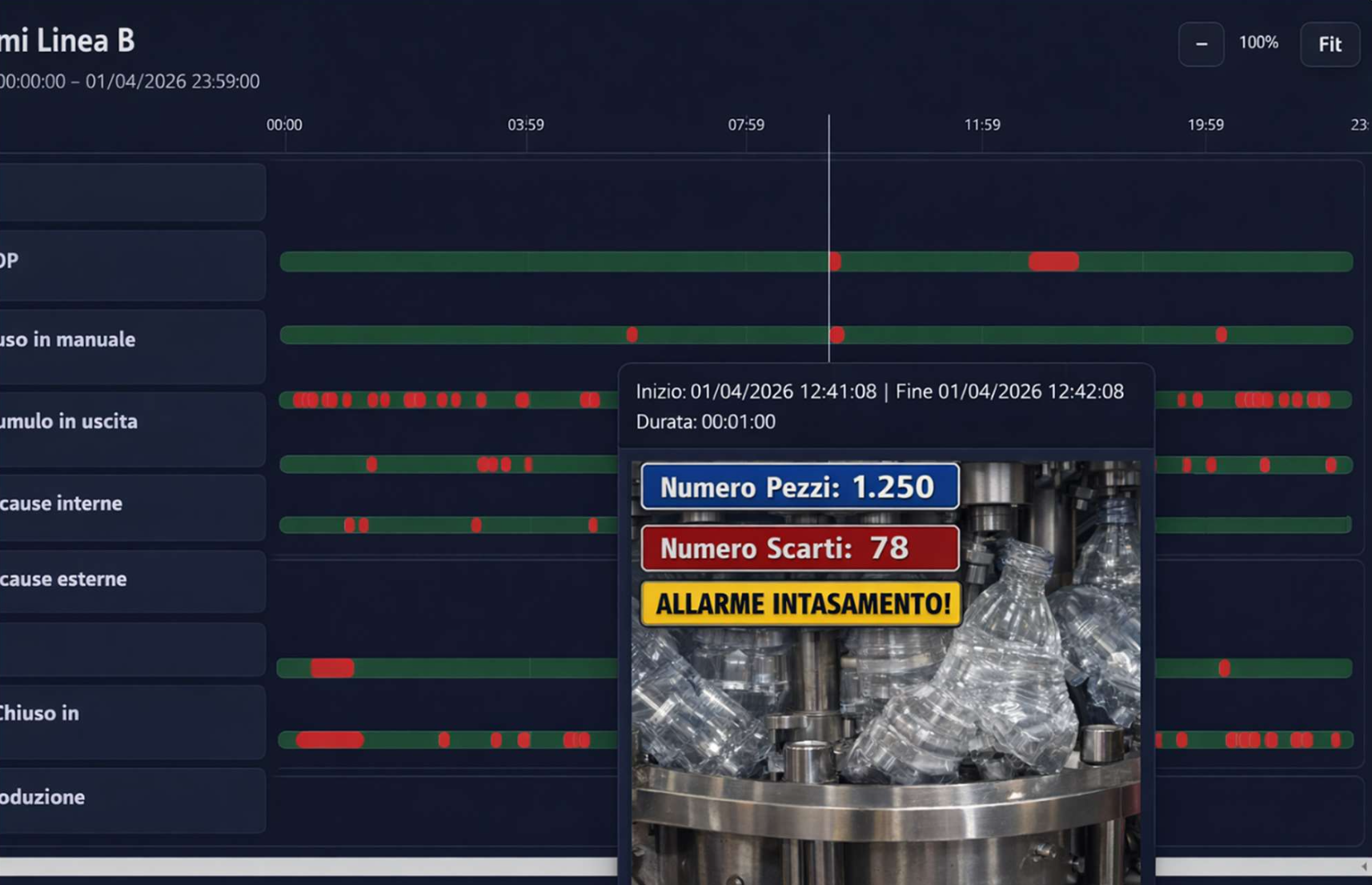
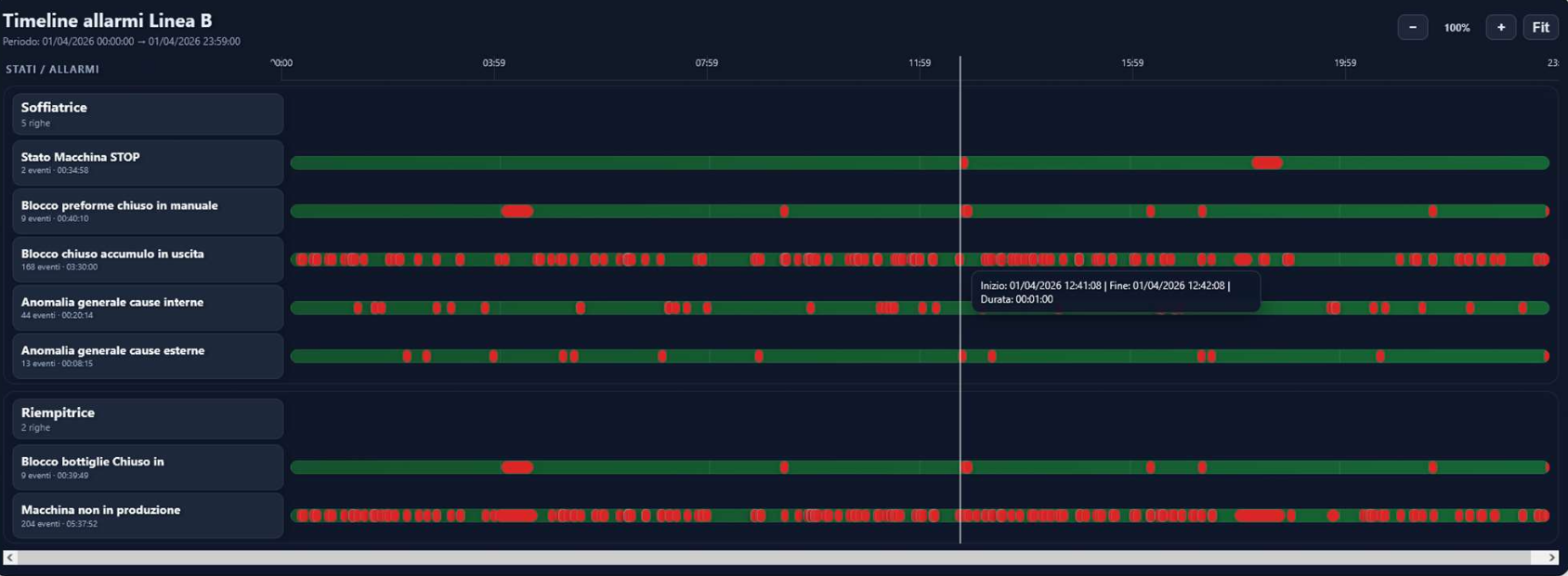
The dashboard supports both operational and managerial analysis. The displayed values make it possible to identify where downtime is concentrated, which causes occur most frequently, which machine most limits the line, and during which time periods issues arise.
For a more comprehensive analysis, production data, scrap, and nominal speed can be integrated to extend the dashboard toward a complete OEE view.
Example outputs:
- Periodic / monthly report
- Daily summary of the selected period
- Line availability
- Blow molder availability
- Filler availability
- Events of the day
- Top daily cause
The NEXA platform was integrated into the existing infrastructure by connecting it to the automation network through dedicated gateways and direct communication with PLC and SCADA systems. This phase included careful parameterization of machine states and relevant events, ensuring meaningful data collection aligned with actual production dynamics.
A key step was the training activities for operators and technical staff, including targeted sessions to clarify the meaning of machine states and the use of dashboards. This helped promote informed adoption of the tool and more effective interpretation of the available information.
The first weeks after startup were dedicated to a data validation phase, during which automatic counts were compared with actual operations, with adjustments made to parameter calibration and correction of any anomalies. This process ensured precise alignment between the system and production.
In this context, NEXA was conceived not as a simple monitoring tool, but as a true operational support system capable of guiding decisions and improving daily line management. Central to this was the alignment between automation, data, and organization: only through this integration is it possible to ensure the reliability of downtime, scrap, and setup time data, transforming data into a concrete tool for continuous improvement.
Future perspectives
The evolution of the MES role from Industry 4.0 to Industry 5.0 marks a significant step in the digital transformation of manufacturing companies. During the Industry 4.0 era, MES became essential for optimizing the entire production process through automation and real-time data analysis, with the goal of maximizing operational efficiency and product quality.
Experience shows that the real value lies not just in the plant itself, but in the capacity to interpret the data it generates: a necessary step for those operating today in the world of bottling and packaging.