Master’s Thesis in Food Science and Technology (October 2025) – Catholic University of the Sacred Heart – supervisor Giorgia Spigno (giorgia.spigno@unicatt.it); co-supervisor Andrea Bassani (andrea.bassani@unicatt.it)
Faced with the emerging global crisis linked to waste management, the high quantity of by-products from the agri-food industry represents a significant environmental and economic challenge. Worldwide, a large amount of food waste is generated, amounting to 58 million tonnes per year in the European Union alone. Although reducing waste is an essential measure, finding solutions to make use of food waste is also an excellent strategy. In fact, residues from the agri-food industry should be considered a valuable resource, as most of them contain a high concentration of bioactive components, pigments, proteins, essential oils, enzymes and dietary fibre.
At the same time, the plastics industry is undergoing a green revolution, driven by the continuous increase in fossil fuel costs and the associated environmental impact. It is estimated that global plastics production accounts for approximately 6% of oil consumption, and these resources are expected to be depleted within approximately 50 years. In this scenario, bioplastics, defined as polymers derived from renewable and/or biodegradable resources, have taken on a central role in both research and industry, thanks to their potential to replace fossil fuels and mitigate environmental impact.
Purpose
The aim of this project was to promote the circular economy, innovation and sustainability through the implementation of new materials for food packaging. Specifically, the aim of this thesis was to develop and evaluate a bioplastic food packaging material with integrated bioactive fillers derived from agri-food by-products, in order to enhance them and reduce waste (Figure 1). In addition, the use of fillers, in addition to decreasing the amount of plastic required, can give the polymer itself improved properties and release bioactive substances, such as antimicrobial compounds or antioxidants, potentially able to prolong the shelf life of food and further reduce waste.
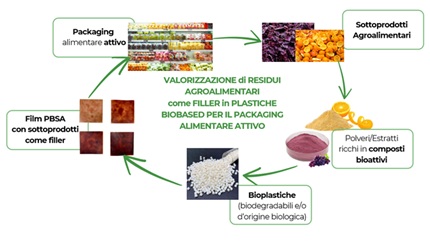
The project was divided into two main phases. The first concerned the chemical and physical characterisation of dried and ground residual biomass and their extract. Subsequently, these matrices were incorporated into a biodegradable polymer by extrusion, obtaining a bioplastic film. The second phase focused on evaluating the functional properties of the material obtained, examining the antioxidant and antimicrobial activity of the film.
In addition, compliance with the current regulations on materials and articles intended for contact with food (MOCA) was verified, in particular with Regulation (EC) 1935/2004 and Regulation (EU) 10/2011, currently only on the basis of global migration analysis with food simulants.
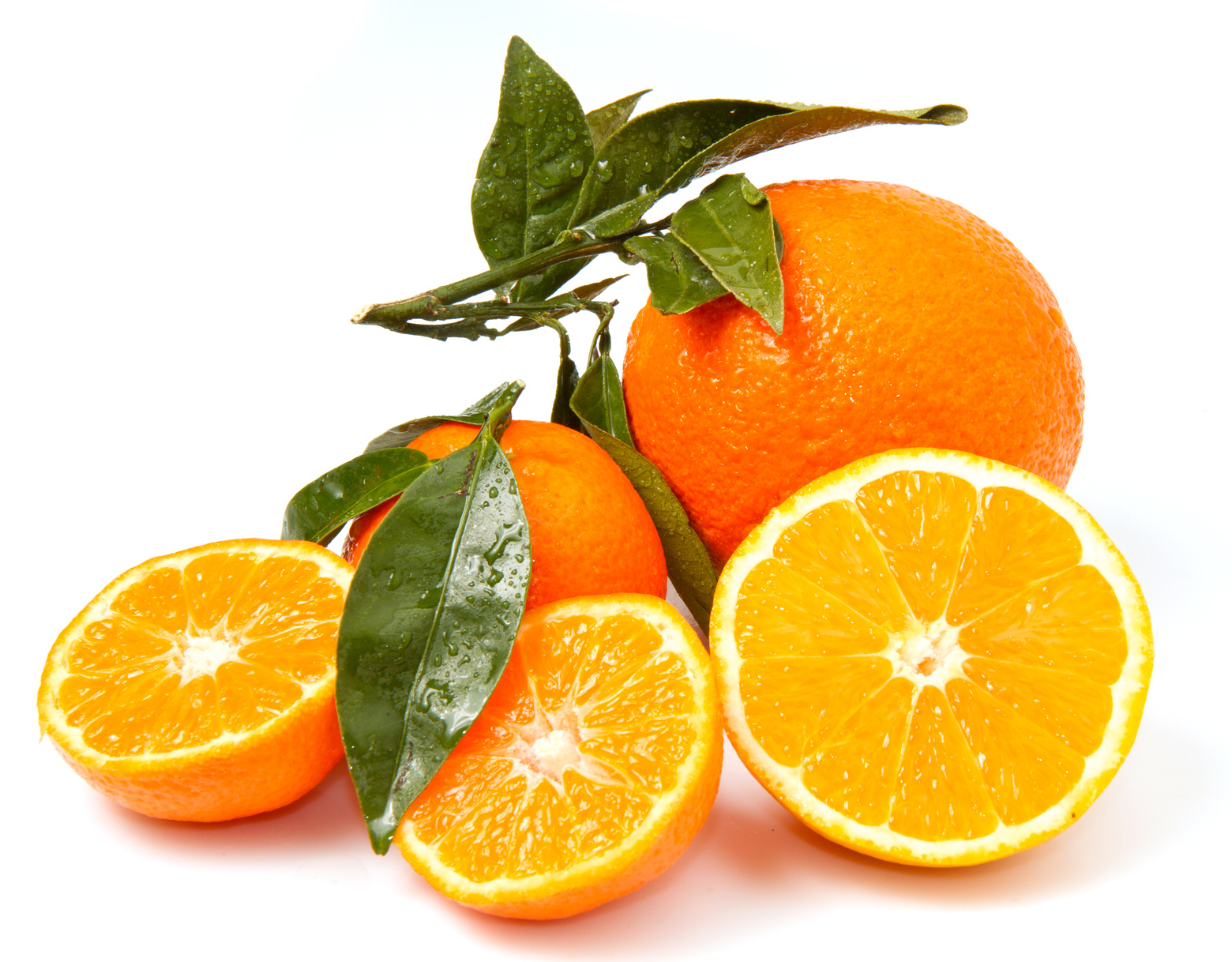
The residual biomass selected for this research was fermented red grape peel (GP) and orange peel (OP), matrices belonging to two of the most widespread fruit supply chains globally (wine and orange juice production respectively), the management of which is becoming complex, making it necessary to develop strategies for reuse. While, for the polymer matrix, the biopolymer PBSA, (poly(butylene succinate co-adipate)) was used. This thesis project was carried out as part of the PNRR ECOSISTER – Ecosystem for Sustainable Transition in Emilia-Romagna” project, funded by the European Union under the National Recovery and Resilience Plan (NRRP).
State of the art
It should be noted that there is extensive literature confirming the potential of the by-products covered by this thesis as a source of bioactive molecules. Numerous studies are also focusing on innovative ways to recover and enhance this biomass. However, research into the use of such by-products as fillers in food packaging materials has been developing mainly over the last decade.
Bibliographic research has shown that the use of natural fillers represents a promising strategy for several reasons: it allows a potential reduction in the cost of bioplastics, since the presence of the filler allows a lower amount of polymer to be used, it favours the reuse of agro-industrial by-products that are otherwise little valued, it can improve the properties of the polymer thanks to the presence of bioactive compounds, and it allows the creation of active packaging, with potential benefits in terms of food preservation and reduction of environmental impact. Research in this field is still relatively recent and the scientific literature, although growing, remains limited, leaving room for the exploration of new solutions. This work has offered the opportunity to investigate new combinations of biopolymers and fillers, exploring their characteristics and functional properties.
Key results
The first phase of the project involved the chemical and physical characterization of the biomass, a crucial step since the chemical and physical properties of the raw materials can significantly influence the mechanical, thermal, and barrier properties of the biopolymer. In particular, cellulose and hemicellulose can affect the material’s elastic modulus. Furthermore, a high content of total extractives suggests a good presence of compounds soluble in water and organic solvents, which could promote better interaction between the filler and the polymer matrix. The characterization results, shown in Table 1, suggested better potential for red grape skin.
Table 1. Characterization of GP and OP. Values are expressed as mean ± standard deviation. The asterisk (*) indicates a statistically significant difference between groups (p<0.05; Student’s t-test)
| Parameters | Fermented red grape skins | Orange peels |
| Humidity (% t.q.) | 4,34 ± 0,19* | 7,33 ± 0,31* |
| Ashes (% s.s.) | 7,54 ± 0,14* | 7,95 ± 0,16* |
| Proteins (% s.s.) | 11,18 ± 0,07* | 7,17 ± 0,39* |
| Total dietary fiber (% s.s.) | 60,04 ± 0,53* | 67,28 ± 0,18* |
| Total lignin (% s.s.) | 37,56 ± 0,79* | 7,65 ± 1,06* |
| Total extractives (% s.s.) | 38,72 ± 0,03 | 20,62 ± 0,01 |
| Cellulose (% s.s.) | 4,32 ± 1,82 | 7,32 ± 0,3 |
| Hemicellulose (% s.s.) | 2,60 ± 1,6 | 5,05 ± 0,24 |
In view of the inclusion of these by-products within the polymer film, it was essential to evaluate the particle size distribution (Figure 2), since the size and concentration of the particles can have a significant impact on the mechanical properties of the material.
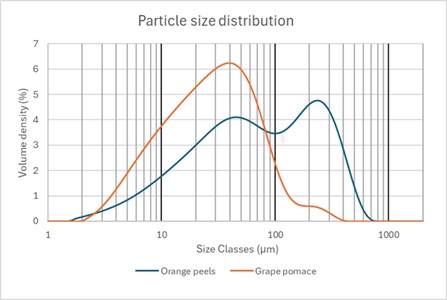
The fermented red grape powder showed a finer particle size and a larger specific surface area, highlighting its better incorporation potential into a food packaging material. This characteristic favors the dispersion of the filler within the matrix, without altering the mechanical properties of the film. Subsequently, analyses were performed to evaluate the total polyphenol content and antioxidant activity of the two byproducts; the results are shown in Table 2.
Table 2. Evaluation of Total Extractable Polyphenol Content and Antioxidant Power. Values are expressed as mean ± standard deviation. The asterisk (*) indicates a statistically significant difference between GP and OP (p < 0.05, Student’s t-test). GAE: gallic acid equivalents; TE: Trolox equivalents; FE: iron equivalents.
| Parameters | Fermented red grape skins | Orange peels |
| Folin (mg GAE/g s.s.) | 22,91 ± 4,96* | 5,21 ± 1,06* |
| Absorbance 280 nm (mg GAE/g s.s.) | 37,44 ± 15,54 | 31,98 ± 14,18 |
| Report Folin/280 | 0,61 | 0,16 |
| DPPH (µmol TE/g s.s.) | 194,85 ± 122,55* | 12,04 ± 6,28* |
| ABTS (mg TE/g s.s.) | 107,79 ± 29,3* | 6,62 ± 3,35* |
| FRAP (µmol FE (II)/g s.s.) | 195,3 ± 12,30* | 38,7 ± 8,80* |
Table 2 compares the extractable polyphenol content (determined by the Folin method and absorbance at 280 nm) and antioxidant activity (assessed by FRAP, DPPH, and ABTS) of the two samples, clearly highlighting the superiority of red grape skin in all parameters analyzed. Based on the results obtained, it was possible to conclude that fermented red grape powder showed greater suitability for use as a filler in biobased plastics. Thanks to the collaboration with the Department of Civil, Chemical, Environmental, and Materials Engineering at the University of Bologna (Professors Laura Sisti and Andrea Saccani), PBSA films containing different percentages of fermented red grape powder were developed using injection molding technology.
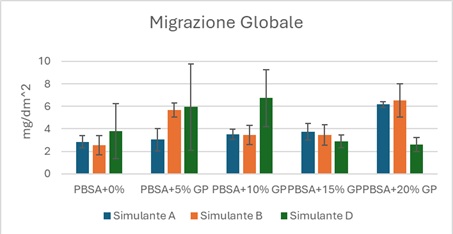
The resulting materials were subjected to global migration tests, in accordance with Regulation (EU) 10/2011, to evaluate the amount of substances that could migrate from the polymer into the food. For the contact test, food simulants A (10% ethanol), B (3% acetic acid), and D2 (olive oil) were used for 10 days at 40°C, simulating all types of food and any prolonged storage at room temperature or below, including packaging under hot-fill conditions. The values obtained for all food simulants and for films with different filler percentages were below the legislative limit of 10 mg/dm², indicating potential suitability for food contact (Figure 3).
Subsequently, simulant D2 was analyzed to assess the possible release of substances capable of slowing lipid oxidation, and thus conferring antioxidant activity to the film. However, no antioxidant effect was observed. Regarding antibacterial potential, the percentage of bacterial inhibition against Staphylococcus aureus and Escherichia coli was evaluated compared to the filler-free PBSA film, following a methodology compliant with ISO 22196:2007.
The results show good antibacterial activity (93–99%), in line with previous studies. The total content of polyphenols migrated into food simulants A and B after the contact test was also analyzed. These results were compared with the theoretical maximum extractable polyphenol content, thus allowing the percentage release to be calculated, which was found to be between 1% and 8%.
Conclusions
The aim of this thesis was to develop and evaluate a bioplastic material based on PBSA, integrated with a filler derived from an agri-food by-product containing potential bioactive compounds, for applications in food packaging. The analyses carried out showed that red grape peel has greater potential than orange peel as a filler, thanks to its finer grain size, higher specific surface area, more favourable chemical-physical composition and higher polyphenol content associated with high antioxidant activity.
The developed film demonstrated good mechanical and thermal performance up to a 15% inclusion of grape skin powder (the results obtained by the University of Bologna are not reported here). The films, at all inclusion percentages, complied with Regulation (EU) 10/2011 regarding global migration tests, under the test conditions used. Furthermore, the results relating to bacterial inhibition and polyphenol release in food simulants highlighted the material’s potential as active packaging, capable of contributing to food preservation.
However, effective industrial application will require further investigation, including a thorough food safety assessment through specific migration and NIAS release tests, testing on real foods, scaling up the production process, and evaluating potential applications. This thesis has therefore contributed to understanding the potential of PBSA with red grape skin filler in the sustainable food packaging sector.