In 2025, sales of organic products in the Italian market reached € 6.9 billion, marking a +6.2% increase compared to 2024: € 5.5 billion relates to domestic consumption, while over € 1.35 billion relates to the out-of-home channel. These are some of the figures from the Osservatorio SANA that Nomisma presented yesterday at Bologna Fiere during Rivoluzione Bio, an initiative promoted by BolognaFiere, in collaboration with FederBio and Assobio, with the support of the Italian Trade Agency (ICE) and the scientific supervision of Nomisma, to take stock of the present and future of organic farming.
Domestic consumption
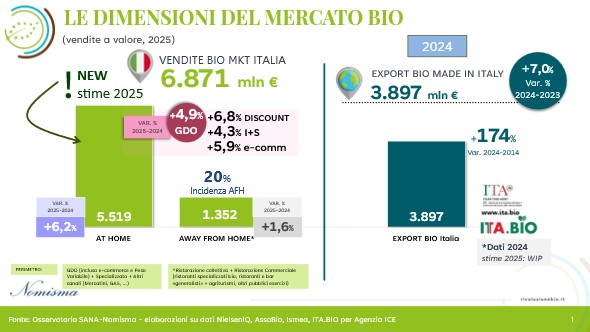
The main channel for domestic consumption is modern distribution (64%), which recorded sales of € 3.5 billion (+6.1%), followed by shops specialising in organic products (20%), up +7.5% (source: Nomisma estimates based on Nielsen IQ data, 2025 vs 2024, omnichannel).
…and out-of-home
In 2025, 7 out of 10 Italians consumed organic food or beverages outside the home (out of home); of these, 35% are classified as “frequent users”.
Furthermore, more than 8 out of 10 restaurants and 7 out of 10 bars use ingredients/offer organic products, especially fruit and vegetables, extra virgin olive oil, purées, milk, honey and organic wines; the latter are “presented” by 85% of restaurateurs and bars.
The main reasons for including organic products in their offerings are the desire to give the establishment a premium positioning linked to the distinctive quality characteristics of organic products (51%), the perception of organic products as an expression of ethical and sustainable choices (46%) and consistent with consumer health and wellbeing needs (40%), and the synergy between the various players in the supply chain, which leads some restaurateurs (38%) to offer organic products at the “request” of local producers.
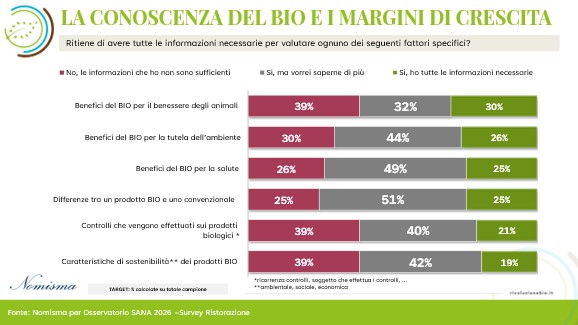
The survey also reveals that 75% of food service operators do not have sufficient information about organic production methods and their effects on the environment, health and animal welfare: a gap that limits the full potential of organic products and highlights the need for more training and communication.
However, food service operators have growing confidence in the potential of organic products: 26% expect an increase in the value of organic raw material purchases over the next 2-3 years. At the same time, 28% expect fewer opportunities for eating out as families seek to reduce spending, making each outing more selective and oriented towards experiential venues and quality offerings.
“The data from the SANA Observatory” – said Maria Grazia Mammuccini, President of FederBio – “show that organic farming is growing and becoming increasingly mature, with an “away from home” component that is now strategic, capable of attracting new consumers and enhancing the supply chain. The fact that 7 out of 10 Italians have consumed organic food away from home and that restaurants and bars are increasingly including it in their menus and offerings is a strong signal that must, however, be supported by greater investment in training and communication. The survey shows that most operators want to increase their knowledge of production methods and the effects of organic farming on the environment, health and animal welfare. To achieve this goal, we firmly believe that new relationships must be built between agricultural producers and the out-of-home catering sector in order to enhance supply chains capable of producing quality and identity in the territories, creating economic and social networks that are fundamental for the regeneration of rural areas”.